Which one of the following compounds has the lowest boiling point?
Answer & explanation
Correct answer: option 2
The correct answer is Option (2) → tert-Butyl chloride
Boiling points of haloalkanes depend on the van der Waals forces between molecules.
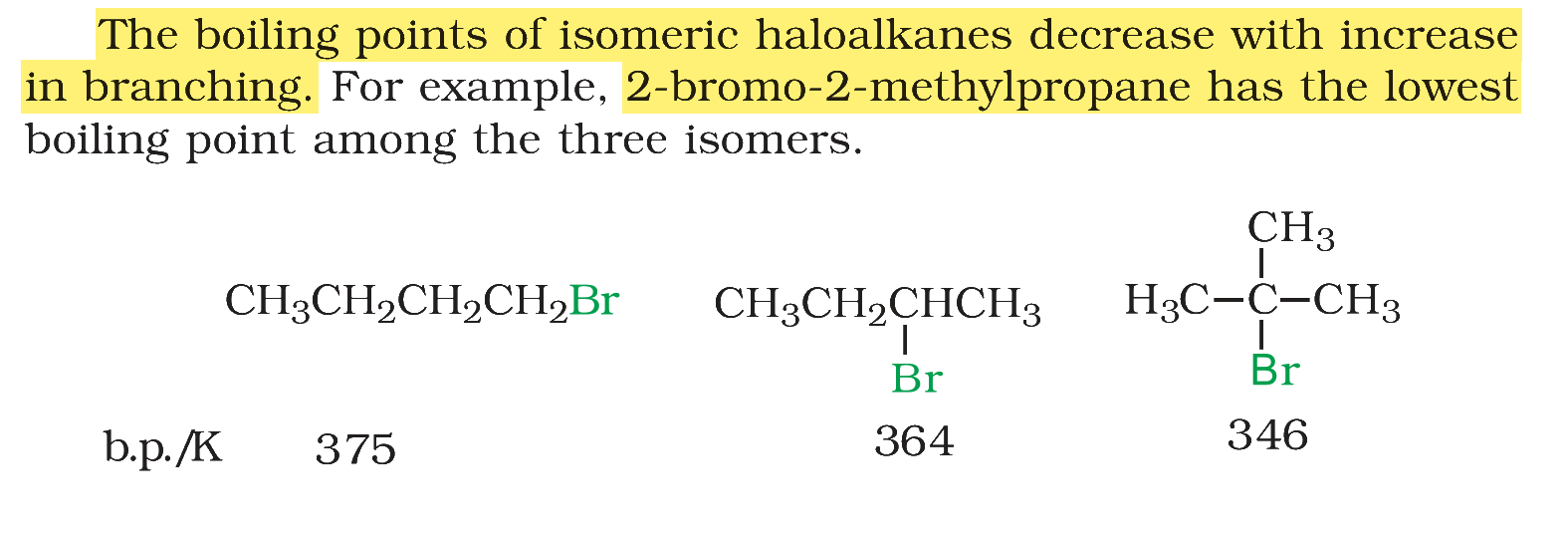
These forces grow with molecular mass and fall as the chain becomes more branched, because a branched molecule is more compact and has less surface for contact.
Three options are isomeric butyl chlorides, \( \ce{C4H9Cl} \). Of these, tert-butyl chloride, \( \ce{(CH3)3CCl} \), (2-chloro-2-methylpropane) is the most branched, so it has the lowest boiling point, as 2-bromo-2-methylpropane does among the isomeric bromobutanes.
Why the other options are incorrect
Option (1) Pentyl chloride — Incorrect. \( \ce{C5H11Cl} \) has one more carbon and a higher molecular mass than the butyl chlorides, so its boiling point is the highest of the four.
Option (3) Isobutyl chloride — Incorrect. \( \ce{(CH3)2CHCH2Cl} \) has one branch, so it boils lower than n-butyl chloride but higher than the more branched tert-butyl chloride.
Option (4) n-Butyl chloride — Incorrect. \( \ce{CH3CH2CH2CH2Cl} \) is a straight chain, so it has the highest boiling point among the three isomers.
NCERT (2026-27 edition):
6.6 Physical Properties