
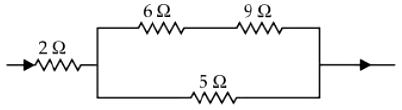
In the circuit shown in the figure, the current through the \( 5\,\Omega \) resistor is 3 A. The heat developed per second in the \( 2\,\Omega \) resistor is
Answer & explanation
Correct answer: option 2
The correct answer is Option (2) → \( 32\,\mathrm{J\,s^{-1}} \)
Resistors in parallel have the same potential difference across them, and a resistor in series carries the whole current. The heat developed per second in a resistor is \( P=I^{2}R \).
From the figure, the \( 2\,\Omega \) resistor carries the whole current, which then divides between the \( 6\,\Omega+9\,\Omega \) branch and the \( 5\,\Omega \) branch.
The potential difference across the parallel part is:
\( \begin{aligned} V &= I_5\,R_5 \\ &= 3\,\mathrm{A}\times5\,\Omega \\ &= 15\,\mathrm{V} \end{aligned} \)
The current in the upper branch is:
\( \begin{aligned} I_{\mathrm{upper}} &= \frac{V}{R_6+R_9} \\ &= \frac{15\,\mathrm{V}}{6\,\Omega+9\,\Omega} \\ &= 1\,\mathrm{A} \end{aligned} \)
The current through the \( 2\,\Omega \) resistor is:
\( \begin{aligned} I &= I_5+I_{\mathrm{upper}} \\ &= 3\,\mathrm{A}+1\,\mathrm{A} \\ &= 4\,\mathrm{A} \end{aligned} \)
The heat developed per second in it is:
\( \begin{aligned} P &= I^{2}R_2 \\ &= (4\,\mathrm{A})^{2}\times2\,\Omega \\ &= 32\,\mathrm{J\,s^{-1}} \end{aligned} \)