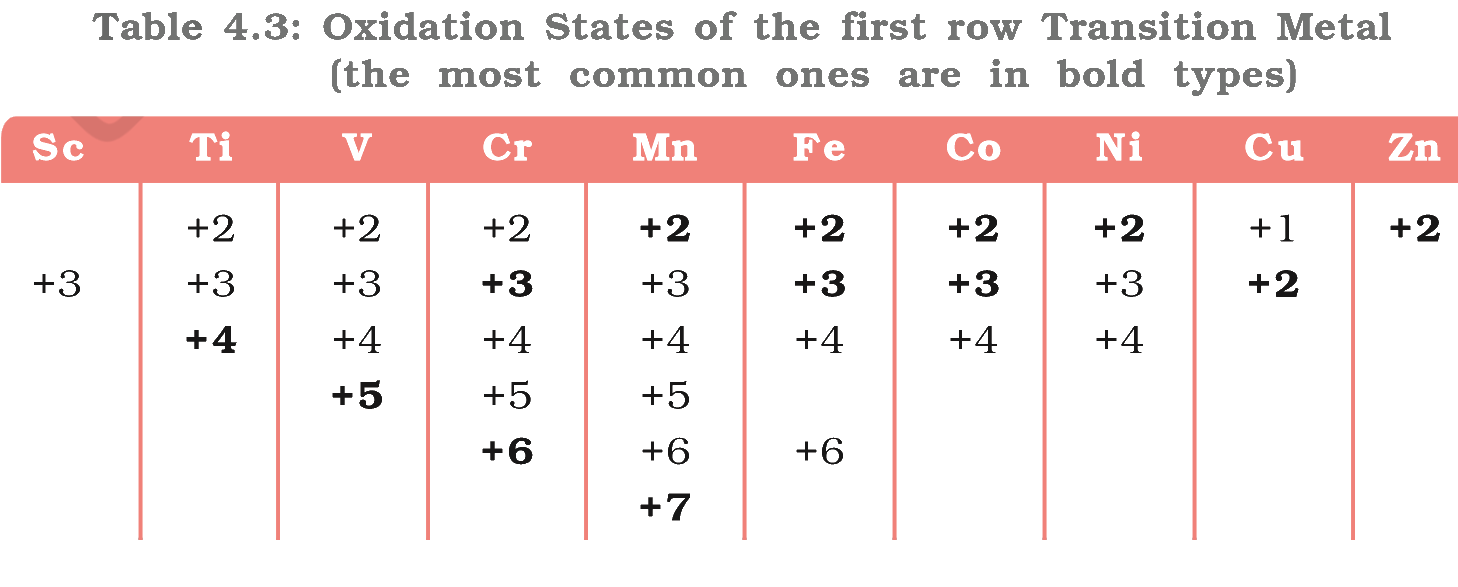
Arrange the following elements in increasing order of their highest possible oxidation states:
A. V
B. Cr
C. Mn
D. Ti
Choose the correct answer from the options given below:
Answer & explanation
Correct answer: option 2
The correct answer is Option (2) → D, A, B, C
In the first half of the 3d series, a transition metal can use all its 4s and 3d electrons in bonding. So its highest oxidation state equals the total number of (n−1)d and ns electrons, and it rises by one from element to element up to manganese:
Ti (Z = 22): [Ar]3d24s2, four electrons → +4 (\( \ce{TiCl4} \), \( \ce{TiO2} \))
V (Z = 23): [Ar]3d34s2, five electrons → +5 (\( \ce{V2O5} \))
Cr (Z = 24): [Ar]3d54s1, six electrons → +6 (\( \ce{CrO3} \), \( \ce{Cr2O7^{2-}} \))
Mn (Z = 25): [Ar]3d54s2, seven electrons → +7 (\( \ce{MnO4^{-}} \), \( \ce{Mn2O7} \))
Shortcut: Titanium (D) has the fewest electrons to use and manganese (C) the most. Only Option (2) starts with D and ends with C.
NCERT (2026-27 edition):
Oxidation States – …