CUETMOCK
  • Pricing
  • Mentors
Log inStart freeStart free mocks→

First test, then trust

Try a free CUET mock test.

Join 5,00,000+ students who rehearsed exam day on the exact NTA screen before sitting CUET. On the web and on Android.

Start free mocks →Get the Android app
CUETMOCK

India's #1 CUET Mock Test Platform. Original NCERT-based questions on the exact NTA exam screen — trusted by 5,00,000+ students since CUET 2022.

Get it onGoogle PlayScan to download the CUETMOCK app

Mock tests

  • CUET mock test series
  • Browse all papers
  • Commerce mocks
  • Humanities (Arts) mocks
  • Science mocks
  • Languages & GAT mocks
  • Free practice questions
  • Pricing

Resources

  • CUET exam guide
  • CUET syllabus
  • Universities accepting CUET
  • Expert blogs
  • News & notifications
  • Webinars & counselling
  • CUET score calculator
  • How we estimate your rank
  • FAQs

Company

  • About us
  • Our leadership & team
  • Our toppers
  • Mentors
  • For schools
  • Contact us
  • Terms
  • Privacy
  • Refund policy

Talk to us

+91 7696 6630 56info@cuetmock.comWhatsApp us

Our other platforms

  • JEE Mock — For IIT-JEE aspirants
  • NEET Mock — For NEET aspirants

Newsletter

Exam updates, study material and offers — no spam.

© 2026 NYC Ventures Pvt. Ltd.

701-702, Royal Business Park, Zirakpur, Punjab - 140603

  • Terms of use
  • Privacy policy
  • Refund policy
  • Contact us

iCUETMOCK is an independent preparation platform, not affiliated with the National Testing Agency (NTA). Always check exam details on the official NTA website.

  • Home
  • Mock tests
  • CUET guide
  • Pricing
  • Log in
Home/Practice questions/Accountancy Part A
Accountancy Part AIssue and Redemption of Debentures

Under which head debentures are shown in the Balance Sheet of a compa…

Under which head debentures are shown in the Balance Sheet of a company?

Answer & explanation+

Correct answer: option 2

The correct answer is Option (2) → Long-term borrowings

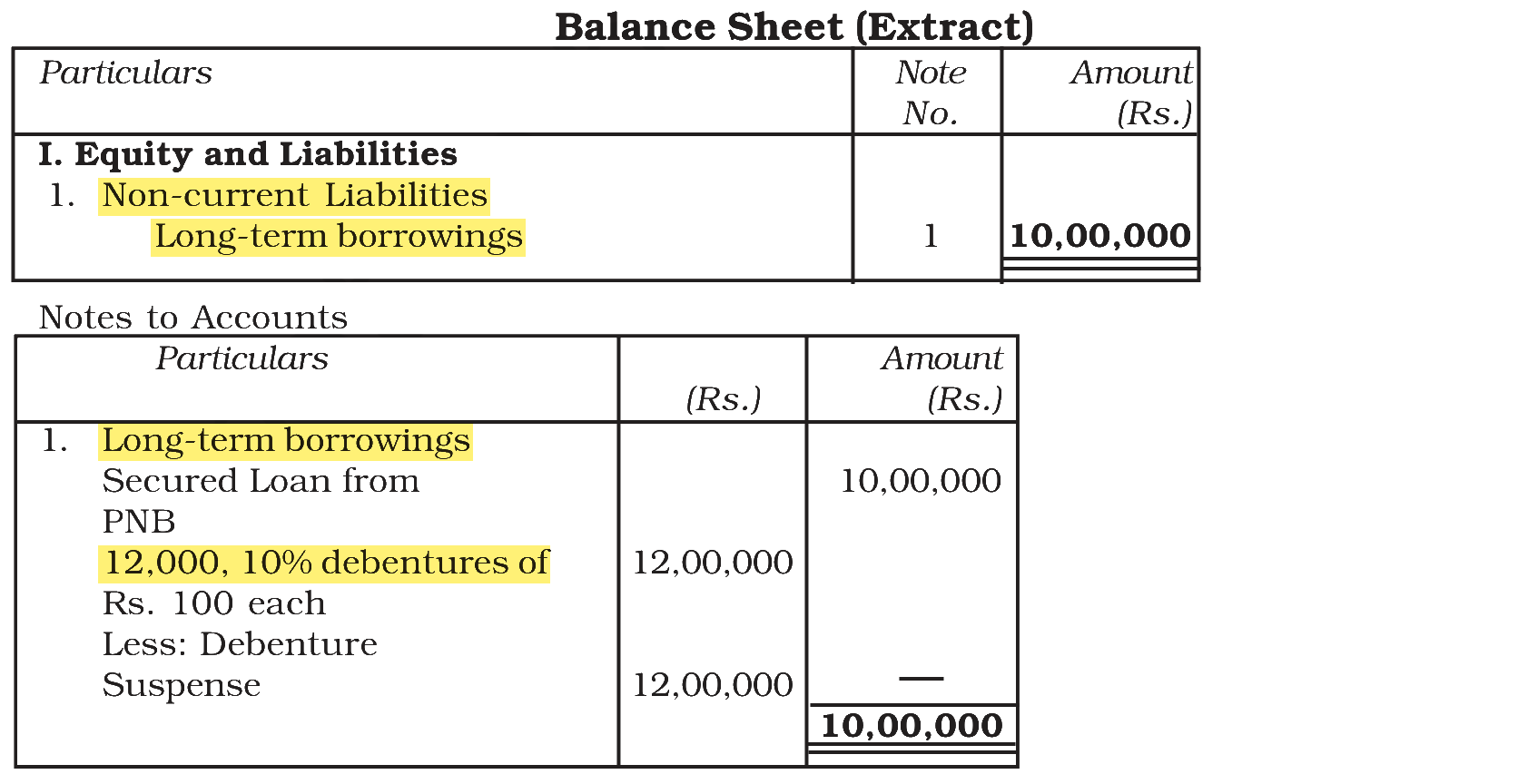
Debentures are loans taken by a company, usually repayable after many years. In the Schedule III balance sheet they are shown under Non-current Liabilities, sub-head Long-term borrowings. Only the part due for redemption within the next twelve months moves to current liabilities. Share capital is the owners' money, so borrowed money such as debentures never goes under it.

Note: A similar question was also asked in CUET (UG) 2025 on 03-06-2025 (Slot 1).

NCERT (2026-27 edition):
Issue of Debentures as a Collateral Security

Extract from the NCERT textbook

Advertisement

Practise more on Issue and Redemption of Debentures

Chapter-wise mocks on the real NTA exam screen, with solutions and your rank. Your first mocks are free.

Start free mocks →

Advertisement

Next questions

  1. The distance between origin and the point of intersection of lines x+y-5=0 and x-y+1=0 , is:General Aptitude Test · Quantitative Reasoning
  2. Fill in the blanks in given in List-I with the most appropriate words from List-II:-List-IList-II(A) Ritu did not get involved in the scand…English · Homonyms
  3. Peptide bond in proteins is structurally represented asChemistry · Organic: Biomolecules
  4. Ovulation is induced by -Biology · Human Reproduction
  5. Which one of the following was not a consequence of the disintegration of the Soviet Union?Political Science · Contemporary World Politics: End of Bi-Polarity
  6. Match the LIST-I with LIST-IILIST-IArtistLIST-IIArt Form/Social IssueA. G. R. SantoshI. Hungry BengalB. ChittoprasadII. Tantric philosophyC…Fine Arts · The Modern Indian Art
  7. Which one of the following phenotypic ratios is correct for dihybrid cross?Biology · Principles of Inheritance and Variation
  8. Choose the Incorrect statement from the options given below:Chemistry · Inorganic: D and F Block Elements
  9. The understanding of the Virashaiva tradition is derived from __________ composed in Kannada.History · Medieval India: Bhakti Sufi Traditions
  10. As per Rule 3 of the Companies (Incorporation) Rules, 2014 which of the following is not true in respect of One Person Company (OPC)?Accountancy Part A · Accounting for Shares