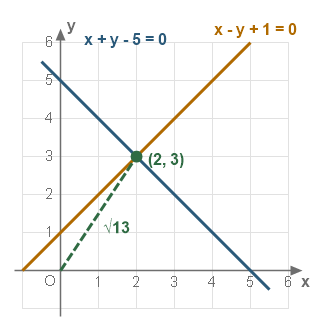
The distance between origin and the point of intersection of lines \(x+y-5=0\) and \(x-y+1=0\), is:
Answer & explanation
Correct answer: option 1
The correct answer is Option (1) → \(\sqrt{13}\)
The point of intersection lies on both lines, so it is the solution of the two equations together; its distance from the origin \((0,0)\) is \(\sqrt{x^{2}+y^{2}}\).
First line: \(x+y=5\) (1)
Second line: \(x-y=-1\) (2)
Adding (1) and (2), the \(y\) terms cancel: \(2x=4\), so \(x=2\), and then \(y=3\)
Distance of \((2,3)\) from the origin \(=\sqrt{2^{2}+3^{2}}=\) \(\sqrt{13}\)