Peptide bond in proteins is structurally represented as
Answer & explanation
Correct answer: option 1
The correct answer is Option (1) → -CO-NH-
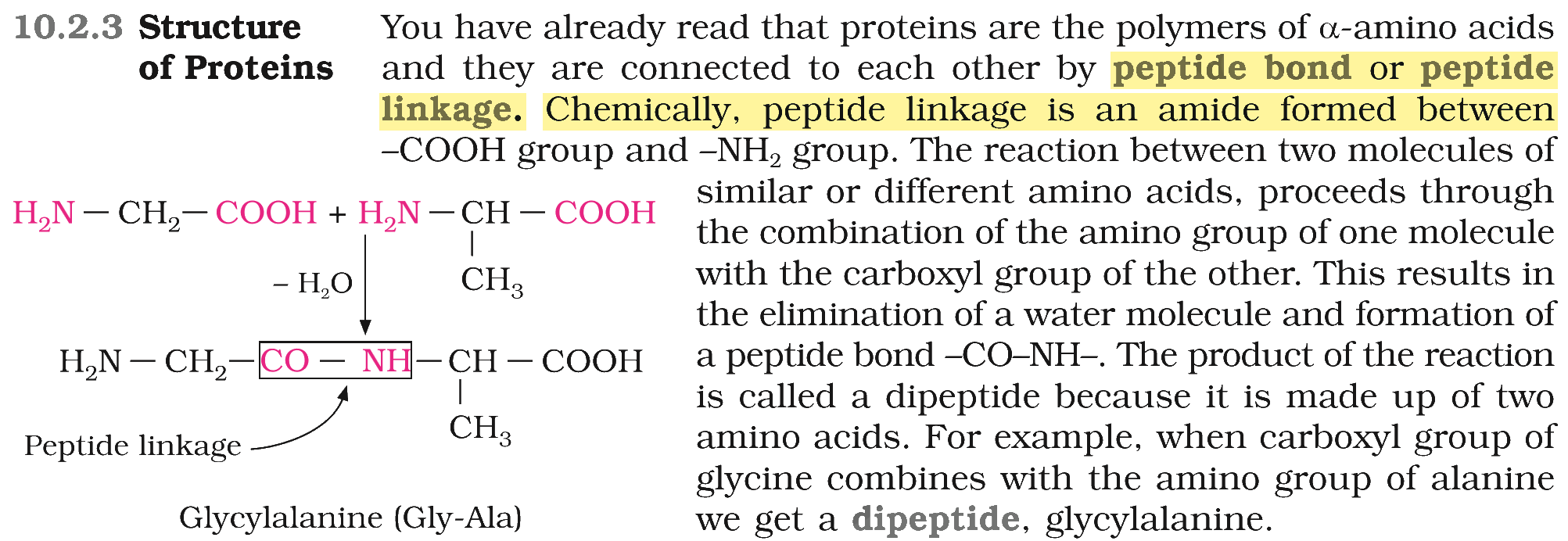
Proteins are long polymers of α-amino acids. Two amino acids join when the –COOH group of one reacts with the –\( \ce{NH2} \) group of the other and a molecule of water is lost. The amide link formed, –CO–NH–, is called the peptide bond.
Each amino acid adds one more –CO–NH– link, so the backbone of a protein is a repeating chain of peptide bonds.
So the peptide bond is represented as –CO–NH–.
Why the other options are incorrect
Option (2) -COO-NH- — Incorrect. Condensation of –COOH with –\( \ce{NH2} \) removes the OH of the acid, so no extra oxygen stays between C and N.
Option (3) -C-O-C- — Incorrect. This is an ether link, the type of glycosidic linkage that joins monosaccharide units in carbohydrates.
Option (4) -C-O-CO- — Incorrect. This is an ester link, found in fats, oils and polyesters, not in proteins.
NCERT (2026-27 edition):
Structure of Proteins