Match List I with List II:
| List I | List II | ||
| (A) | Jatakas | (I) | Mounds with relics of Buddha |
| (B) | Stupas | (II) | Buddhist moral stories |
| (C) | Samanas | (III) | An organization of monks |
| (D) | Sangha | (IV) | Those who have renounced the world |
Choose the correct answer from the options given below:
Answer & explanation
Correct answer: option 2
The correct answer is Option (2) → (A)-(II), (B)-(I), (C)-(IV), (D)-(III)
(A) Jatakas — this matches (II) Buddhist moral stories. The Jatakas are collections of stories, many of them popular oral tales later written down in Pali; several of their animal stories are carved at Sanchi.
(B) Stupas — this matches (I) Mounds with relics of Buddha. Relics of the Buddha, such as his bodily remains or objects used by him, were buried in mounds known as stupas.
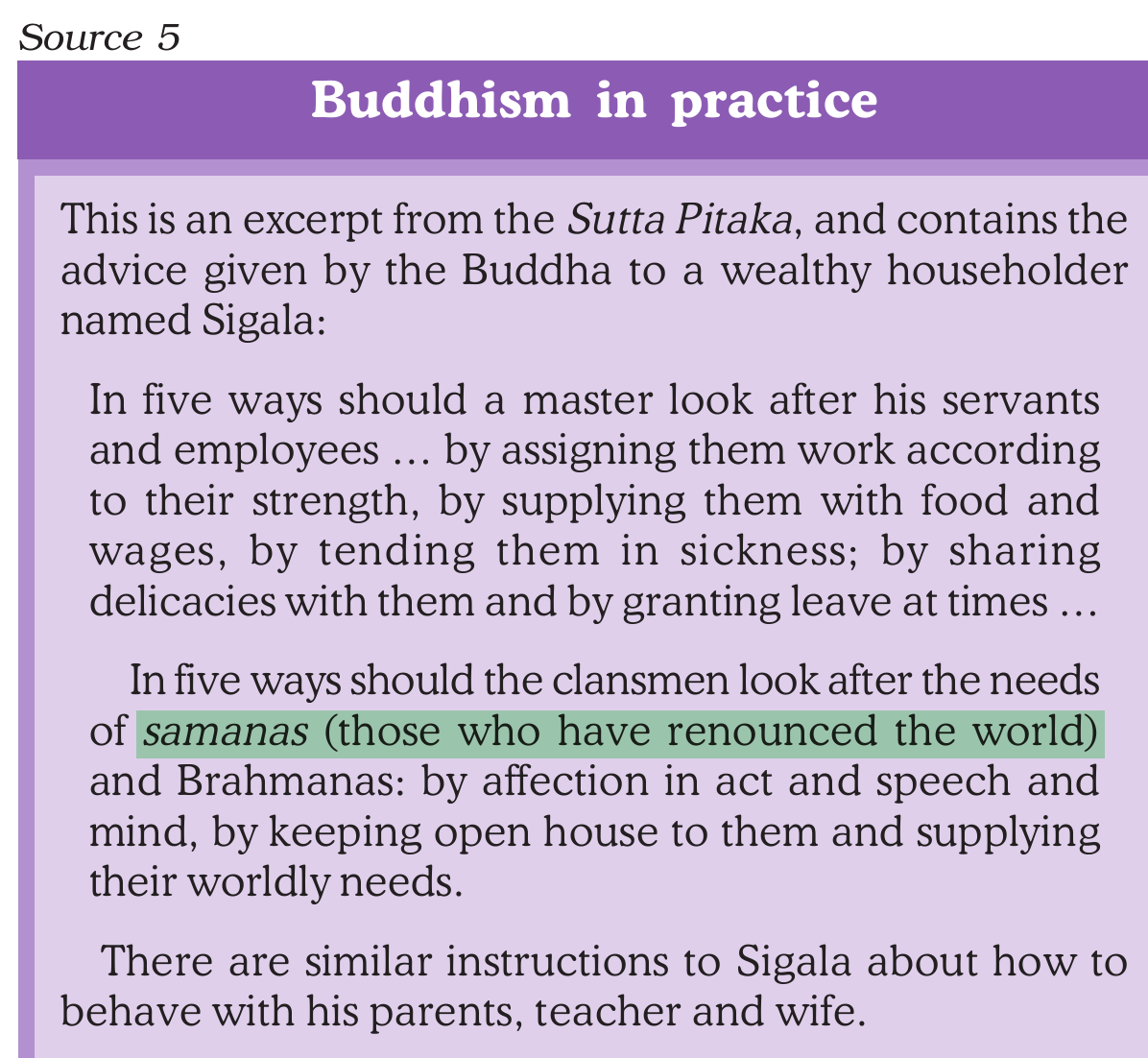
(C) Samanas — this matches (IV) Those who have renounced the world. The Sutta Pitaka asks the clansmen to look after the needs of samanas (those who have renounced the world) and Brahmanas.
(D) Sangha — this matches (III) An organization of monks. The Vinaya Pitaka laid down rules for those who joined the sangha or monastic order.
NCERT (2026-27): “7.1 Why were stupas built? … There were other places too that were regarded as sacred. This was because relics of the Buddha such as his bodily remains or objects used by him were buried there. These were mounds known as stupas. The tradition of erecting stupas may have been pre-Buddhist, but they came to be associated with Buddhism. Since they contained relics regarded as sacred, the entire stupa came to be venerated as an emblem of both the Buddha and Buddhism.… 2.3 Debates and discussions … The Vinaya Pitaka included rules and regulations for those who joined the sangha or monastic order; the Buddha’s teachings were included in the Sutta Pitaka; and the Abhidhamma Pitaka dealt with philosophical matters.… …Nevertheless, historians have tried to solve this problem by examining stories contained in anthologies such as the Jatakas and the Panchatantra. Many of these stories probably originated as popular oral tales that were later committed to writing.…”
|