
CUETMOCK
  • Pricing
  • Mentors
Log inStart freeStart free mocks→

First test, then trust

Try a free CUET mock test.

Join 5,00,000+ students who rehearsed exam day on the exact NTA screen before sitting CUET. On the web and on Android.

Start free mocks →Get the Android app
CUETMOCK

India's #1 CUET Mock Test Platform. Original NCERT-based questions on the exact NTA exam screen — trusted by 5,00,000+ students since CUET 2022.

Get it onGoogle PlayScan to download the CUETMOCK app

Mock tests

  • CUET mock test series
  • Commerce mocks
  • Humanities (Arts) mocks
  • Science mocks
  • Languages & GAT mocks
  • Free practice questions
  • Pricing

Resources

  • CUET exam guide
  • CUET syllabus
  • Universities accepting CUET
  • Expert blogs
  • News & notifications
  • Webinars & counselling
  • CUET score calculator
  • How we estimate your rank
  • FAQs

Company

  • About us
  • Our leadership & team
  • Our toppers
  • Mentors
  • For schools
  • Contact us
  • Terms
  • Privacy
  • Refund policy

Talk to us

+91 7696 6630 56info@cuetmock.comWhatsApp us

Our other platforms

  • JEE Mock — For IIT-JEE aspirants
  • NEET Mock — For NEET aspirants

Newsletter

Exam updates, study material and offers — no spam.

© 2026 NYC Ventures Pvt. Ltd.

701-702, Royal Business Park, Zirakpur, Punjab - 140603

  • Terms of use
  • Privacy policy
  • Refund policy
  • Contact us

iCUETMOCK is an independent preparation platform, not affiliated with the National Testing Agency (NTA). Always check exam details on the official NTA website.

  • Home
  • Mock tests
  • CUET guide
  • Pricing
  • Log in
Home/Practice questions/Chemistry
ChemistryOrganic: Haloalkanes and Haloarenes

By which mechanism does isopropyl chloride (2-chloropropane) undergo…

By which mechanism does isopropyl chloride (2-chloropropane) undergo hydrolysis?

Answer & explanation+

Correct answer: option 1

The correct answer is Option (1) → SN1 and SN2 mechanisms

Isopropyl chloride, \( \ce{(CH3)2CHCl} \), is a secondary (2°) halide: the carbon carrying Cl is bonded to two other carbons.

  • SN2: the nucleophile attacks the carbon from the back, so the rate falls as the carbon gets more crowded: 1° > 2° > 3°. Two methyl groups hinder the attack only moderately, so a 2° halide can still react by SN2.

  • SN1: the C–Cl bond first breaks to give a carbocation, so the rate rises with carbocation stability: 3° > 2° > 1°. A secondary carbocation is stable enough to form, so a 2° halide can also react by SN1.

Lying in the middle of both reactivity orders, 2-chloropropane is hydrolysed by both mechanisms:

    \( \displaystyle \ce{(CH3)2CHCl + OH^- -> (CH3)2CHOH + Cl^-} \)

Why the other options are incorrect

Option (2) Neither SN1 nor SN2 mechanisms — Incorrect. The halogen is on an sp3 carbon, so the halide does undergo nucleophilic substitution and gives propan-2-ol.

Option (3) SN1 mechanism only — Incorrect. Substitution almost only by SN1 is shown by tertiary halides, whose bulky groups block SN2 attack.

Option (4) SN2 mechanism only — Incorrect. Substitution almost only by SN2 is shown by methyl and primary halides, whose carbocations are too unstable for SN1.

NCERT (2026-27 edition):
6.7.1 Reactions of Haloalkanes – “… Tertiary halides are the least reactive because bulky groups hinder the approaching nucleophiles. Thus the order of reactivity followed is: Primary halide > Secondary halide > Tertiary halide.”

“… Further, greater the stability of carbocation, greater will be its ease of formation from alkyl halide and faster will be the rate of reaction. In case of alkyl halides, 3° alkyl halides undergo SN1 reaction very fast because of the high stability of 3° carbocations. We can sum up the order of reactivity of alkyl halides towards SN1 and SN2 reactions as follows:”
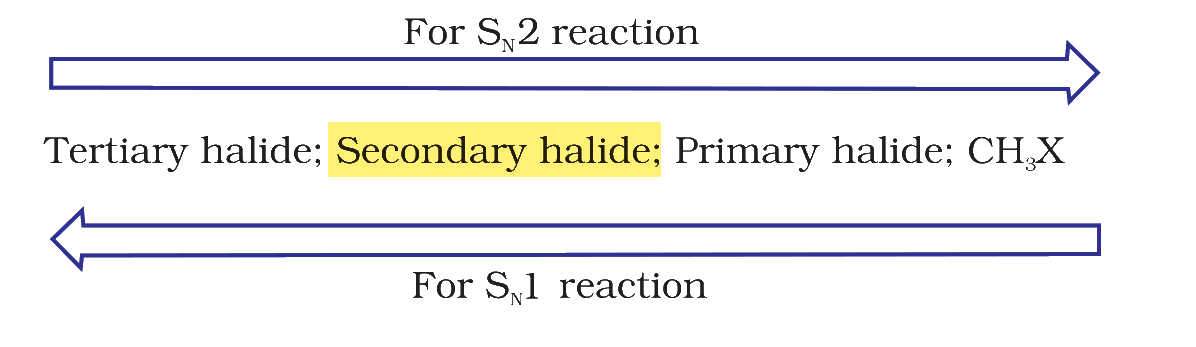
Textbook extract

Advertisement

Practise more on Organic: Haloalkanes and Haloarenes

Chapter-wise mocks on the real NTA exam screen, with solutions and your rank. Your first mocks are free.

Start free mocks →

Advertisement

Next questions

  1. In a class of 55 students, the number of students studying different subjects are, 23 in Mathematics, 24 in Physics, 19 in Chemistry, 12 in…Maths. Section B1 · Relations and Functions
  2. Where can the aggrieved party appeal further in case he is not satisfied with the order of the District Commission?Business Studies · Consumer Protection
  3. When cyclohexane is added to ethyl alcohol, which type of behaviour it will show from Raoult's Law?Chemistry · Physical: Solutions
  4. A sum of money becomes Rs.11880 after 4 years and Rs.17820 after 6 years on compound interest, the interest is compounded annually. What is…General Aptitude Test · Numerical Ability
  5. The ratio of areas of two circles is 81 : 121. What will be the ratio of their circumferences ?General Aptitude Test · Numerical Ability
  6. Five chairs J, H, P, S and M are placed in a row facing towards the east (Not necessarily in the same order). P is second to the left of S.…General Aptitude Test · Verbal Reasoning
  7. Which of the following is the correct full form of CACP?General Aptitude Test · General Knowledge
  8. Who was against the evils of exclusive nationalism?Sociology · Indian Society: Challenges of Cultural Diversity
  9. Three different positions of the same dice are shown. Find the number on the face opposite the face having '3'.General Aptitude Test · Verbal Reasoning
  10. Choose the most appropriate option to fill in the blank:On the day of the bandh, ______ of the shops in Sadar Bazaar opened their shutters.English · Grammar: Determiner