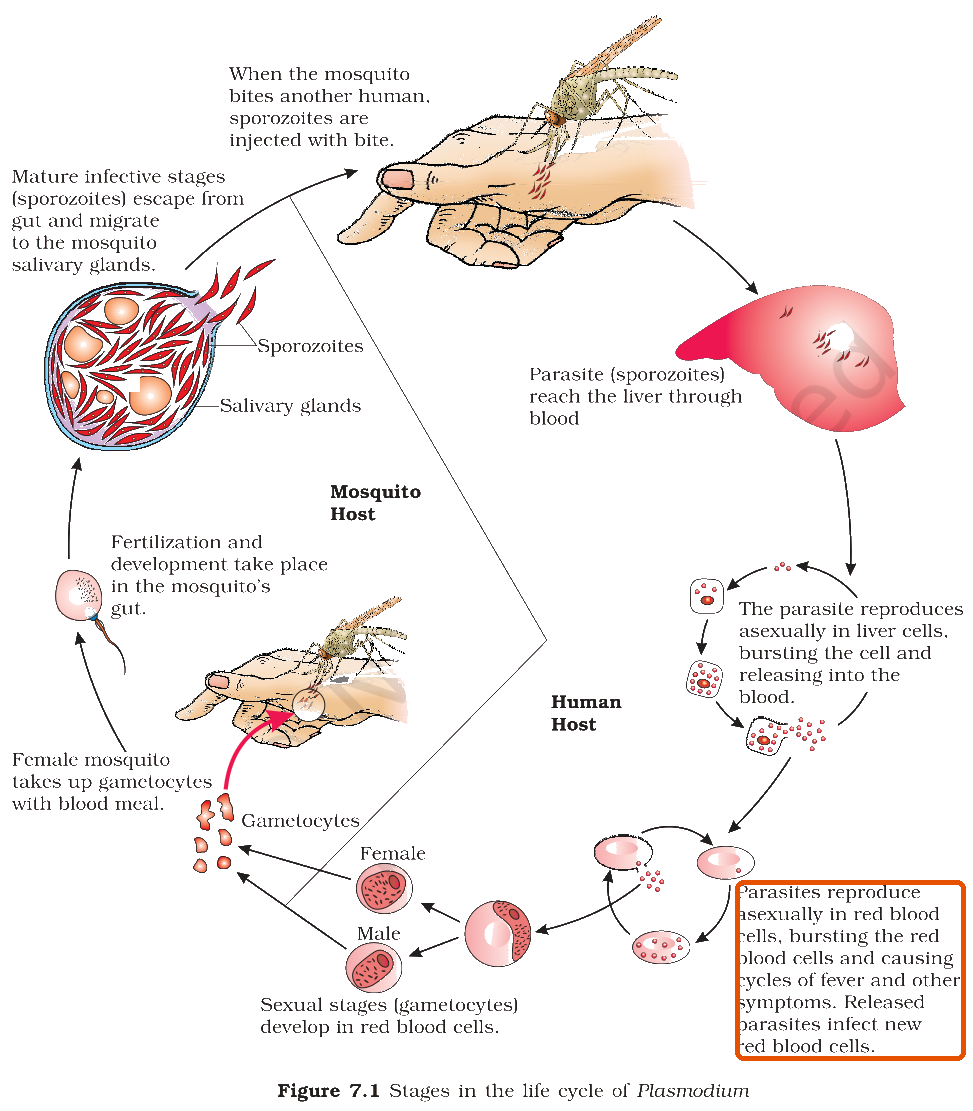
Toxic substance released with rupturing of RBC during malaria fever is:
Answer & explanation
Correct answer: option 3
The correct answer is Option (3) → Haemozoin
Option (1) Haematoxyline — Incorrect. Haematoxylin is a dye used to stain tissues for the microscope. It has nothing to do with malaria.
Option (2) Haematin — Incorrect. Haematin is a pigment formed from the haem part of haemoglobin. It is not the toxin that causes the malarial fever.
Option (3) Haemozoin — Correct. Haemozoin comes from the red blood cells that the parasite has attacked. It is set free when these cells burst, and it brings on the fever of malaria.
Option (4) Haemin — Incorrect. Haemin is another compound made from haem in the laboratory. It is not released by the malarial parasite.
NCERT Extract:
Common Diseases in Humans – “… Let us take a glance at the life cycle of Plasmodium (Figure 7.1). Plasmodium enters the human body as sporozoites (infectious form) through the bite of infected female Anopheles mosquito. The parasites initially multiply within the liver cells and then attack the red blood cells (RBCs) resulting in their rupture. The rupture of RBCs is associated with release of a toxic substance, haemozoin, which is responsible for the chill and high fever recurring every three to four days.”