
Chlorobenzene reacts with acetyl chloride in anhydrous $AlCl_3$ to give major product as
Answer & explanation
Correct answer: option 3
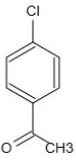
The correct answer is Option (3) →
$\text{Molality (m)} = \frac{\text{moles of solute}}{\text{mass of solvent in kg}}$
Step 1: Moles of Ethanoic Acid
Molar mass of $\text{CH}_3\text{COOH} = \text{C}_2\text{H}_4\text{O}_2 = 2 \times 12 + 4 \times 1 + 2 \times 16 = 60\text{ g/mol}$
$\text{Moles} = \frac{1.5}{60} = 0.025\text{ mol}$
Step 2: Mass of Solvent in kg
$25\text{ g} = 0.025\text{ kg}$
Step 3: Final Molality Calculation
$m = \frac{0.025}{0.025} = 1.0\text{ mol kg}^{-1}$
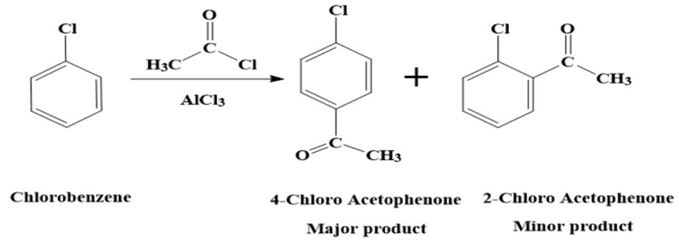
This is a Friedel–Crafts acylation reaction.
- Reagent system: Acetyl chloride $(\text{CH}_3\text{COCl}) + \text{AlCl}_3$
- Electrophile formed: Acylium ion $(\text{CH}_3\text{CO}^+)$
- Substrate: Chlorobenzene
Chlorine is:
- Deactivating ($-I$ effect)
- But ortho/para directing (due to resonance donation)
Because of steric hindrance, the para product is formed in greater amount than ortho.
What gets attached?
An acetyl group $(-\text{COCH}_3)$ substitutes on the ring at ortho and para positions, with para predominating.
Major product = p-Chloroacetophenone
Option Analysis
- Option 1: Acetyl group at ortho position to $Cl$. Correct orientation but sterically less favored than para.
- Option 2: Structure not representing proper direct acyl substitution on ring (side chain type). Not correct FC acylation product.
- Option 3: Acetyl group at para position to $Cl$. Matches directing effect + least steric hindrance. This is the major product.
- Option 4: Shows di-acylation. Chlorobenzene is deactivated; multiple acylation is highly unlikely.