
CUETMOCK
  • Pricing
  • Mentors
Log inStart freeStart free mocks→

First test, then trust

Try a free CUET mock test.

Join 5,00,000+ students who rehearsed exam day on the exact NTA screen before sitting CUET. On the web and on Android.

Start free mocks →Get the Android app
CUETMOCK

India's #1 CUET Mock Test Platform. Original NCERT-based questions on the exact NTA exam screen — trusted by 5,00,000+ students since CUET 2022.

Get it onGoogle PlayScan to download the CUETMOCK app

Mock tests

  • CUET mock test series
  • Commerce mocks
  • Humanities (Arts) mocks
  • Science mocks
  • Languages & GAT mocks
  • Free practice questions
  • Pricing

Resources

  • CUET exam guide
  • CUET syllabus
  • Universities accepting CUET
  • Expert blogs
  • News & notifications
  • Webinars & counselling
  • CUET score calculator
  • How we estimate your rank
  • FAQs

Company

  • About us
  • Our leadership & team
  • Our toppers
  • Mentors
  • For schools
  • Contact us
  • Terms
  • Privacy
  • Refund policy

Talk to us

+91 7696 6630 56info@cuetmock.comWhatsApp us

Our other platforms

  • JEE Mock — For IIT-JEE aspirants
  • NEET Mock — For NEET aspirants

Newsletter

Exam updates, study material and offers — no spam.

© 2026 NYC Ventures Pvt. Ltd.

701-702, Royal Business Park, Zirakpur, Punjab - 140603

  • Terms of use
  • Privacy policy
  • Refund policy
  • Contact us

iCUETMOCK is an independent preparation platform, not affiliated with the National Testing Agency (NTA). Always check exam details on the official NTA website.

  • Home
  • Mock tests
  • CUET guide
  • Pricing
  • Log in
Home/Practice questions/Chemistry
ChemistryOrganic: Amines

The figure shows the intermolecular hydrogen bonding in an amine (R =…

The figure shows the intermolecular hydrogen bonding in an amine (R = alkyl group). The dotted lines are hydrogen bonds.
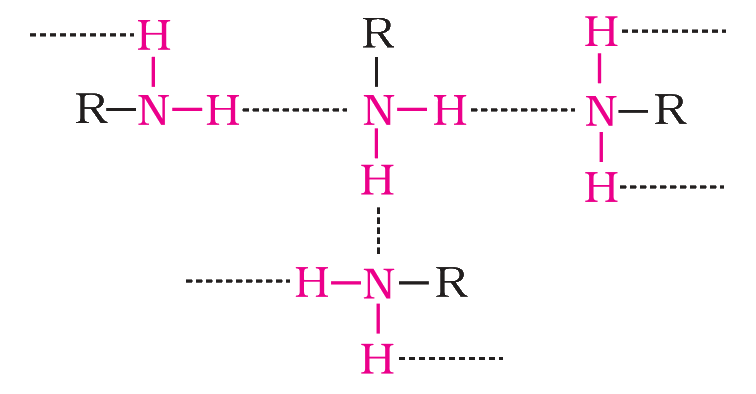
Intermolecular hydrogen bonding in an amine

How many hydrogen atoms on the nitrogen of each molecule are available for hydrogen bond formation, and how does the intermolecular association of this amine compare with that of an isomeric secondary amine?

Answer & explanation+

Correct answer: option 2

The correct answer is Option (2) → Two; more than in the secondary amine

  • Each nitrogen atom in the figure carries one R group and two hydrogen atoms, so the amine is R–NH2, a primary amine. Both N–H hydrogens form hydrogen bonds with the nitrogen of neighbouring molecules.

  • A secondary amine, R2NH, has only one such hydrogen, so the intermolecular association of the primary amine is more. This is why a primary amine boils higher than its isomeric secondary amine.

Why the other options are incorrect

Option (1) One; less than in the secondary amine — Incorrect. Each nitrogen in the figure has two hydrogen atoms, not one, and with two hydrogens the association is more, not less.

Option (3) Two; less than in the secondary amine — Incorrect. The count is right, but two N–H hydrogens give more hydrogen bonds than the single N–H hydrogen of a secondary amine, so the association is more.

Option (4) One; more than in the secondary amine — Incorrect. One N–H hydrogen is the case of a secondary amine itself; the nitrogen atoms in the figure each carry two hydrogens.

NCERT (2026-27 edition):
9.5 Physical Properties – “Primary and secondary amines are engaged in intermolecular association due to hydrogen bonding between nitrogen of one and hydrogen of another molecule. This intermolecular association is more in primary amines than in secondary amines as there are two hydrogen atoms available for hydrogen bond formation in it. … Intermolecular hydrogen bonding in primary amines is shown in Fig. 9.2.”

Fig. 9.2

Fig. 9.2: Intermolecular hydrogen bonding in primary amines

Advertisement

Practise more on Organic: Amines

Chapter-wise mocks on the real NTA exam screen, with solutions and your rank. Your first mocks are free.

Start free mocks →

Advertisement

Next questions

  1. What was the total number of goals scored in the finals of the FIFA World Cup 2018?General Aptitude Test · General Knowledge
  2. Match List – I with List – II. List - I List - II (A) Accumulated Profits/Losses (I) New Ratio (B) Share of goodwill at the time of admissi…Accountancy Part A · Reconstitution of Partnership Firm: Retirement and Death
  3. Three of the following four letter-clusters are alike in a certain way and one is different. Pick the odd one out.General Aptitude Test · General Ability
  4. Select the correct homonym from the given options to fill in the blank. The police returned to the________of the crime.English · Fill Blanks
  5. With an increase in marginal propensity to consume the value of investment multiplier will :Economics · Macro Economics: Determination of Income and Employment
  6. In the figure, assuming the diodes to be ideal:-Physics · Semiconductors and Electronic Devices
  7. A sum of ₹4,620 is to be paid back in 2 equal annual instalments. How much is each instalment (in ₹) if the interest is compounded annually…General Aptitude Test · Numerical Ability
  8. What is the packing efficiency in fcc unit cell?Chemistry · Physical: Solid State
  9. After 4 hours, 1/16 of the initial amount of a certain radioactive isotope remains undecayed. What is the half life of the isotope?Physics · Nuclei
  10. Pick the set of parts from ((A), (B), (C) and (D)) that join together to form a complete square. A part may be turned round but its size ca…General Aptitude Test · Non-Verbal Reasoning