
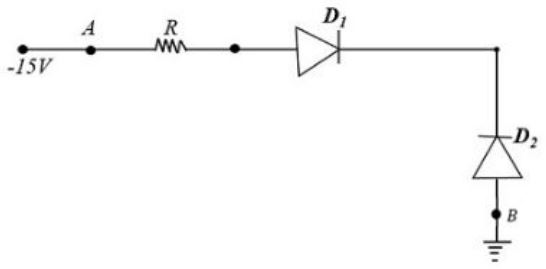
In the figure, assuming the diodes to be ideal:-
Answer & explanation
Correct answer: option 1
The correct answer is Option (1) → $D_2$ is forward biased and $D_1$ is reverse biased and hence no current flows from B to A and vice-versa
Node at left (A) is tied to −15 V source (through R, so anode of D1 ≈ −15 V). Bottom node B = 0 V (ground).
D1 orientation: anode at left node, cathode at the vertical node to the right.
Forward condition for D1: $V_{\text{anode}} - V_{\text{cathode}} \geq 0.7\ \text{V}$.
D2 orientation: anode at bottom (B = 0 V), cathode at the vertical node.
Forward condition for D2: $V_{B} - V_{\text{vertical}} \geq 0.7\ \text{V} \;\;\Rightarrow\;\; V_{\text{vertical}} \leq -0.7\ \text{V}$.
Since the left supply is −15 V, the vertical node will be at a negative potential (less than 0 V). Hence
$V_{B} - V_{\text{vertical}} \geq 0.7\ \text{V} \;\;\Rightarrow\;\;$ D2 is forward biased.
$V_{\text{anode(D1)}} - V_{\text{cathode(D1)}} \lt 0\ \text{V} \;\;\Rightarrow\;\;$ D1 is reverse biased.
Therefore, D2 conducts and D1 is off; no continuous current path exists between A and B through both diodes.
Correct option: D2 forward biased and D1 reverse biased; hence no current flows from B to A and vice-versa.