Read the passage given below carefully and answer the questions that follow :-
The problem of household garbage is common in most Indian cities. Despite the increasing concern for clean environment we do not know to what extent citizens are aware about how to dispose the garbage at home. Sanyogita, a high school teacher took the lead to organise a team comprising of her colleagues in school and started going door to door in the nearby colonies to educate people on how to separate domestic waste and hand it over to the garbage collection agencies. She also avidly read about methods used by other developed countries and felt distressed when she observed how callous some people were towards keeping a clean environment. The local newspapers appreciated Sanyogita's efforts and applauded her publicly. Sanyogita's students and children joined her mission to segregate garbage and send the bio-degradable waste to the nearby recycle plant.
Identify the behavioural component of the attitude displayed by Sanyogita towards the environment:
Answer & explanation
Correct answer: option 1
The correct answer is Option (1) → Sanyogita took the lead to organise a team of teachers and started going door to door in the nearby colonies.
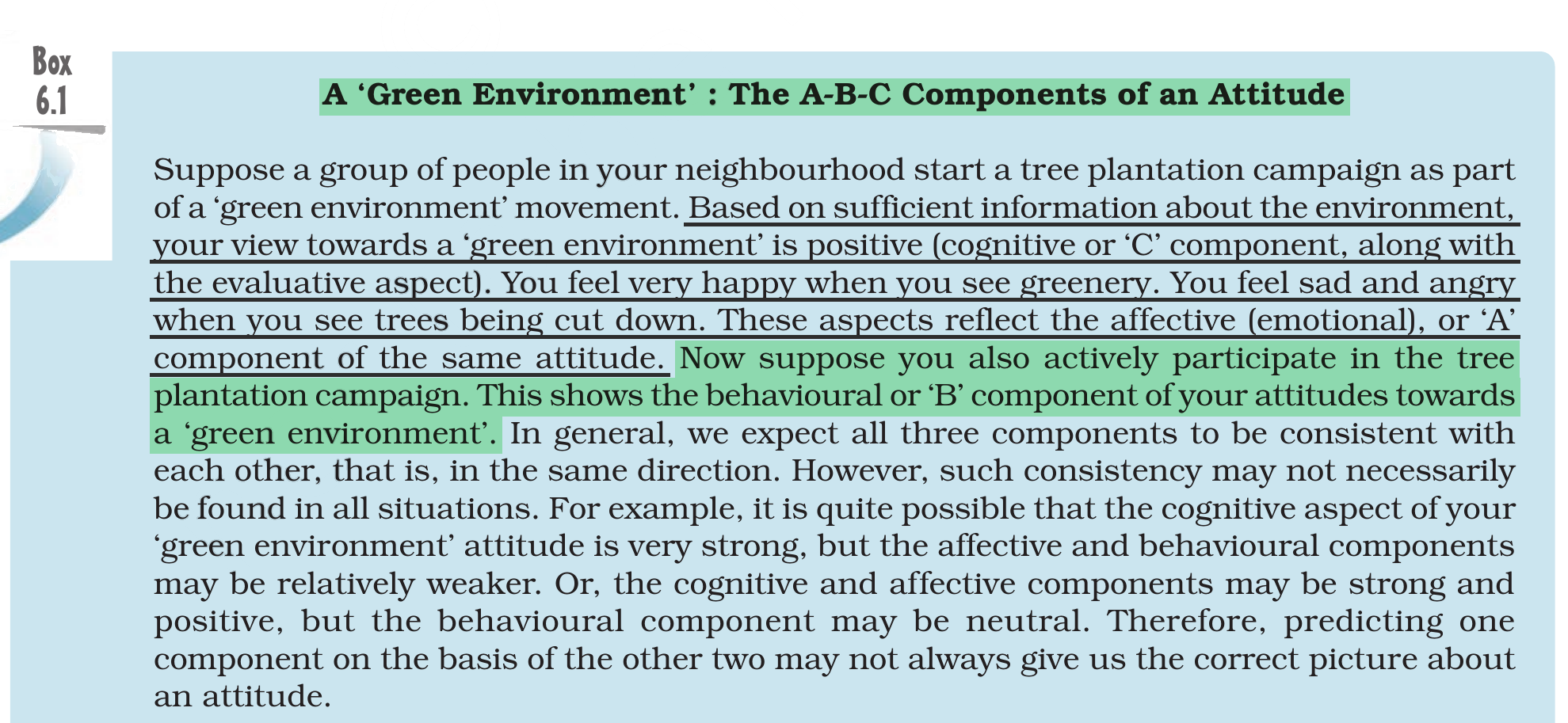
Option (1) Sanyogita took the lead to organise a team ... — Correct. The behavioural (conative) component is the tendency to act towards the attitude object. Organising a team and going door to door to educate people is Sanyogita acting on her attitude, as actively joining a tree plantation campaign shows the behavioural component of a ‘green environment’ attitude.
Option (2) She avidly read about methods used by developed countries. — Incorrect. Reading gathers information and views about the attitude object, which is the cognitive component.
Option (3) She felt distressed when people were callous about their environment. — Incorrect. Distress is a feeling, so this is the affective component.
Option (4) Sanyogita’s students and children joined her mission. — Incorrect. This is behaviour, but it is the behaviour of her students and children, not of Sanyogita. The question asks for the behavioural component of Sanyogita’s own attitude.
NCERT (2025-26): “Nature and Components of Attitudes … All definitions of attitudes agree that an attitude is a state of the mind, a set of views, or thoughts, regarding some topic (called the ‘attitude object’), which have an evaluative feature (positive, negative or neutral quality). It is accompanied by an emotional component, and a tendency to act in a particular way with regard to the attitude object. The thought component is referred to as the cognitive aspect, the emotional component is known as the affective aspect, and the tendency to act is called the behavioural (or conative) aspect. Taken together, these three aspects have been referred to as the A-B-C components (Affective-Behavioural-Cognitive components) of attitude.…”
|