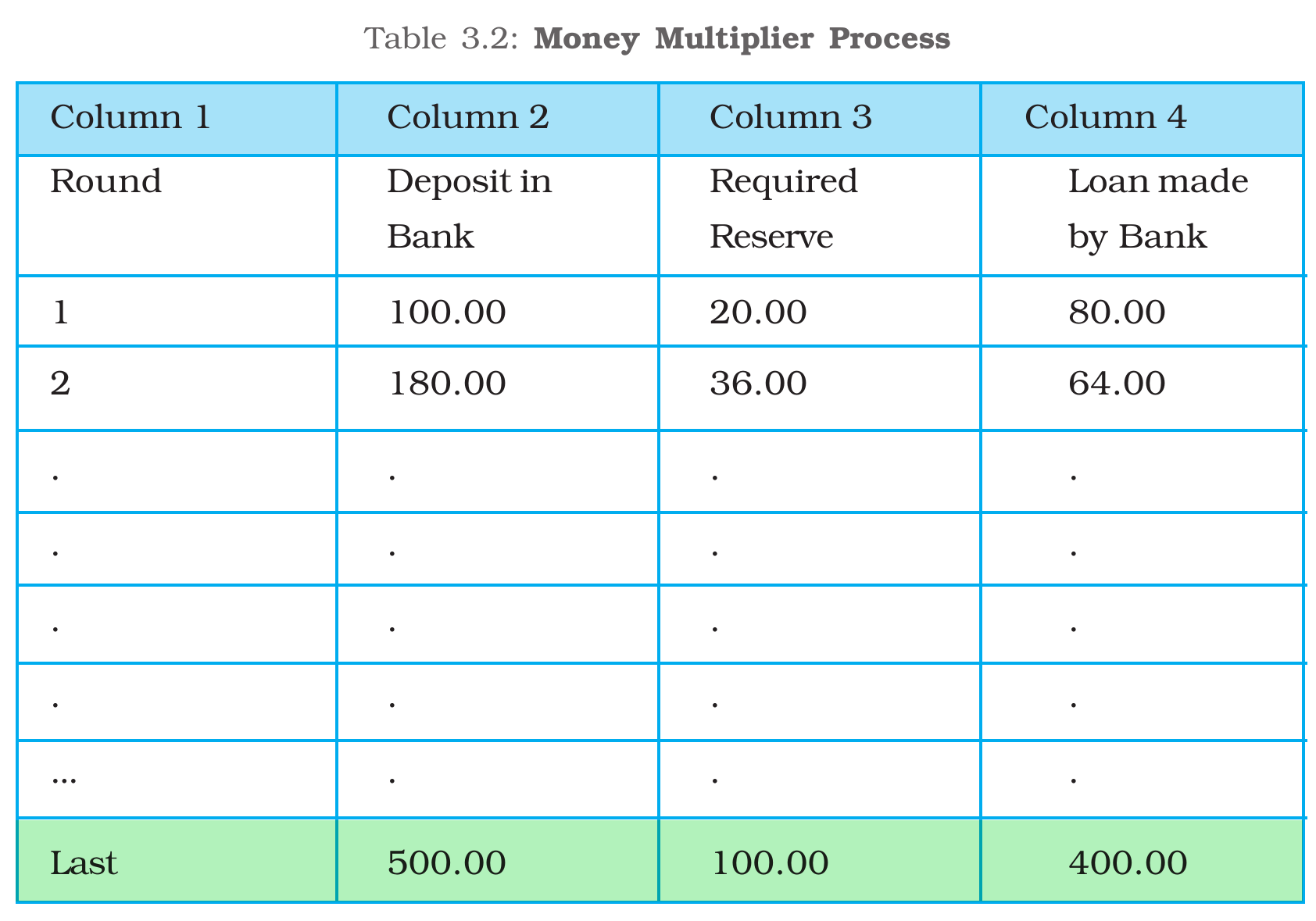
How much total credit creation can a bank create with Cash Reserve Ratio of 20% when bank's reserves are Rs. 1000.
Answer & explanation
Correct answer: option 1
The correct answer is Option (1) → 5000
Given:
Reserves of the bank = Rs. 1000
Cash reserve ratio, CRR = 20 per cent = 0.20
The money multiplier is 1 divided by the CRR. Reserves support deposits equal to reserves × money multiplier.
\( \displaystyle \text{Money multiplier} = \frac{1}{0.20} = 5 \)
Total credit created = 1000 × 5 = Rs. 5,000
Note: One can argue that ‘total credit creation’ means only the loans made by the bank, as in the ‘Loan made by Bank’ column of the NCERT table. Then the loans are Rs. 4,000 (Rs. 5,000 of deposits minus Rs. 1,000 of reserves), which is Option (4).
NCERT (2026-27): “3.3.2 Limits to Credit Creation and Money Multiplier … The statutory requirement of the reserve ratio acts as a limit to the amount of credit that banks can create.… The required reserves will be Rs 100 only when the total deposits become Rs 500. This is because for deposits of Rs 500, cash reserves would have to be Rs 100 (20 per cent of 500 = 100). The process is illustrated in Table 3.2.… …Since the bank is only expected to keep 20 per cent of its deposits as reserves, thus, reserves of Rs 100 (20per cent of 500 = 100) can support the deposits of Rs 500. In other words, our bank can give a loan of Rs 400.…”
|