
CUETMOCK
  • Pricing
  • Mentors
Log inStart freeStart free mocks→

First test, then trust

Try a free CUET mock test.

Join 5,00,000+ students who rehearsed exam day on the exact NTA screen before sitting CUET. On the web and on Android.

Start free mocks →Get the Android app
CUETMOCK

India's #1 CUET Mock Test Platform. Original NCERT-based questions on the exact NTA exam screen — trusted by 5,00,000+ students since CUET 2022.

Get it onGoogle PlayScan to download the CUETMOCK app

Mock tests

  • CUET mock test series
  • Commerce mocks
  • Humanities (Arts) mocks
  • Science mocks
  • Languages & GAT mocks
  • Free practice questions
  • Pricing

Resources

  • CUET exam guide
  • CUET syllabus
  • Universities accepting CUET
  • Expert blogs
  • News & notifications
  • Webinars & counselling
  • CUET score calculator
  • How we estimate your rank
  • FAQs

Company

  • About us
  • Our leadership & team
  • Our toppers
  • Mentors
  • For schools
  • Contact us
  • Terms
  • Privacy
  • Refund policy

Talk to us

+91 7696 6630 56info@cuetmock.comWhatsApp us

Our other platforms

  • JEE Mock — For IIT-JEE aspirants
  • NEET Mock — For NEET aspirants

Newsletter

Exam updates, study material and offers — no spam.

© 2026 NYC Ventures Pvt. Ltd.

701-702, Royal Business Park, Zirakpur, Punjab - 140603

  • Terms of use
  • Privacy policy
  • Refund policy
  • Contact us

iCUETMOCK is an independent preparation platform, not affiliated with the National Testing Agency (NTA). Always check exam details on the official NTA website.

  • Home
  • Mock tests
  • CUET guide
  • Pricing
  • Log in
Home/Practice questions/Chemistry
ChemistryInorganic: D and F Block Elements

How many unpaired electrons are present in Ni^2+ ? (Atomic number of…

How many unpaired electrons are present in \(Ni^{2+}\)? (Atomic number of Ni = 28)

Answer & explanation+

Correct answer: option 3

The correct answer is Option (3) → 2

Unpaired electrons are counted from the d-electron configuration of the ion, filling the five 3d orbitals singly first and then pairing.

  • Oxidation state of Ni: the ion carries a charge of 2+, so Ni is in the +2 state.

  • Configuration: Ni (Z = 28) is [Ar]3d84s2; losing the two 4s electrons gives \( \ce{Ni^2+} \): [Ar]3d8.

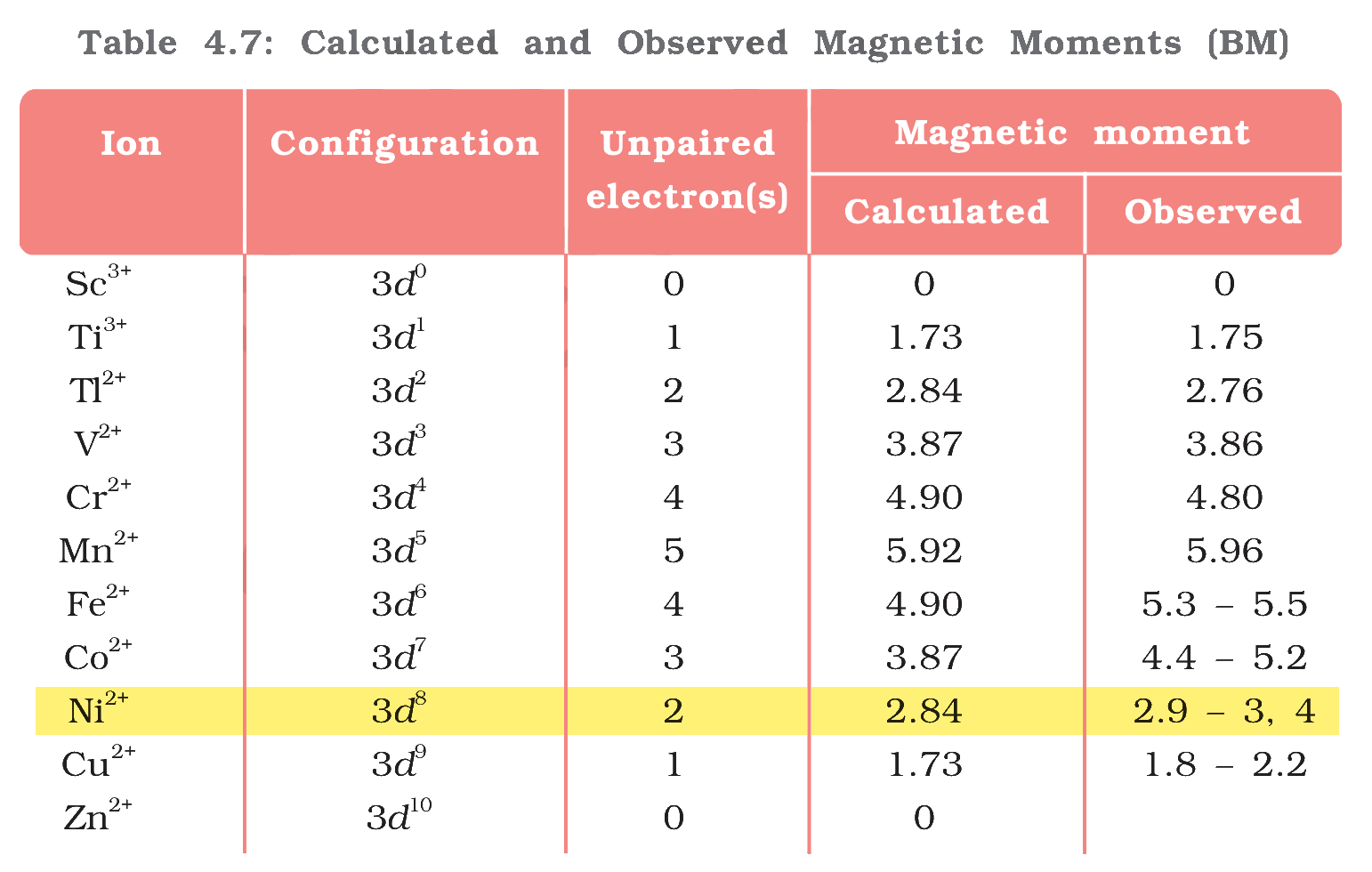
  • Unpaired electrons: 8 electrons in five 3d orbitals give three pairs and two single electrons, so \( \ce{Ni^2+} \) has 2 unpaired electrons.

NCERT (2026-27 edition):
Table 4.7: Calculated and Observed Magnetic Moments (BM)
Textbook table

Advertisement

Practise more on Inorganic: D and F Block Elements

Chapter-wise mocks on the real NTA exam screen, with solutions and your rank. Your first mocks are free.

Start free mocks →

Advertisement

Next questions

  1. Find the mean proportion of 1/25 and 1/49 .General Aptitude Test · Numerical Ability
  2. If x + 1/x = 10, then find the value of 7x/(x^2 + 1- 8x).General Aptitude Test · Quantitative Reasoning
  3. 'चिर' उपसर्ग से बने शब्द हैं: A. चिरागB. चिरायुC. चिरपरिचितD. चिरकालE. चिंतितHindi · व्याकरण - सउपसर्ग
  4. Which of the following statements is correct?Statement A- Minorities are groups that have common language or religion and in a particular p…Political Science · Rights In The Indian Constitution
  5. Consider the following statements about the duration of psychotherapy:(A) The duration of classical psychoanalysis may continue for several…Psychology · Therapeutic Approaches
  6. The appropriate reagent for the following conversion is:Chemistry · Organic: Haloalkanes and Haloarenes
  7. Which of the following diseases is caused by virus?General Aptitude Test · General Knowledge
  8. A shopkeeper marks his goods 25% above the cost price and gives 20% discount to customers. At the time of selling the goods, he uses 800 gm…General Aptitude Test · Numerical Ability
  9. Under the new industrial policy of July 1991, how was permission granted for technology agreements with foreign companies?Business Studies · Business Environment
  10. The first country in world to have family planning programme is _______.Sociology · Indian Society: Demographic Structure of Indian Society