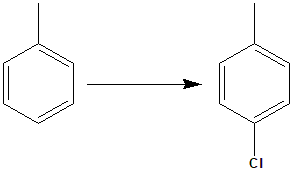
The appropriate reagent for the following conversion is:
Answer & explanation
Correct answer: option 3
The correct answer is Option (3) → \(Cl_2/FeCl_3\)
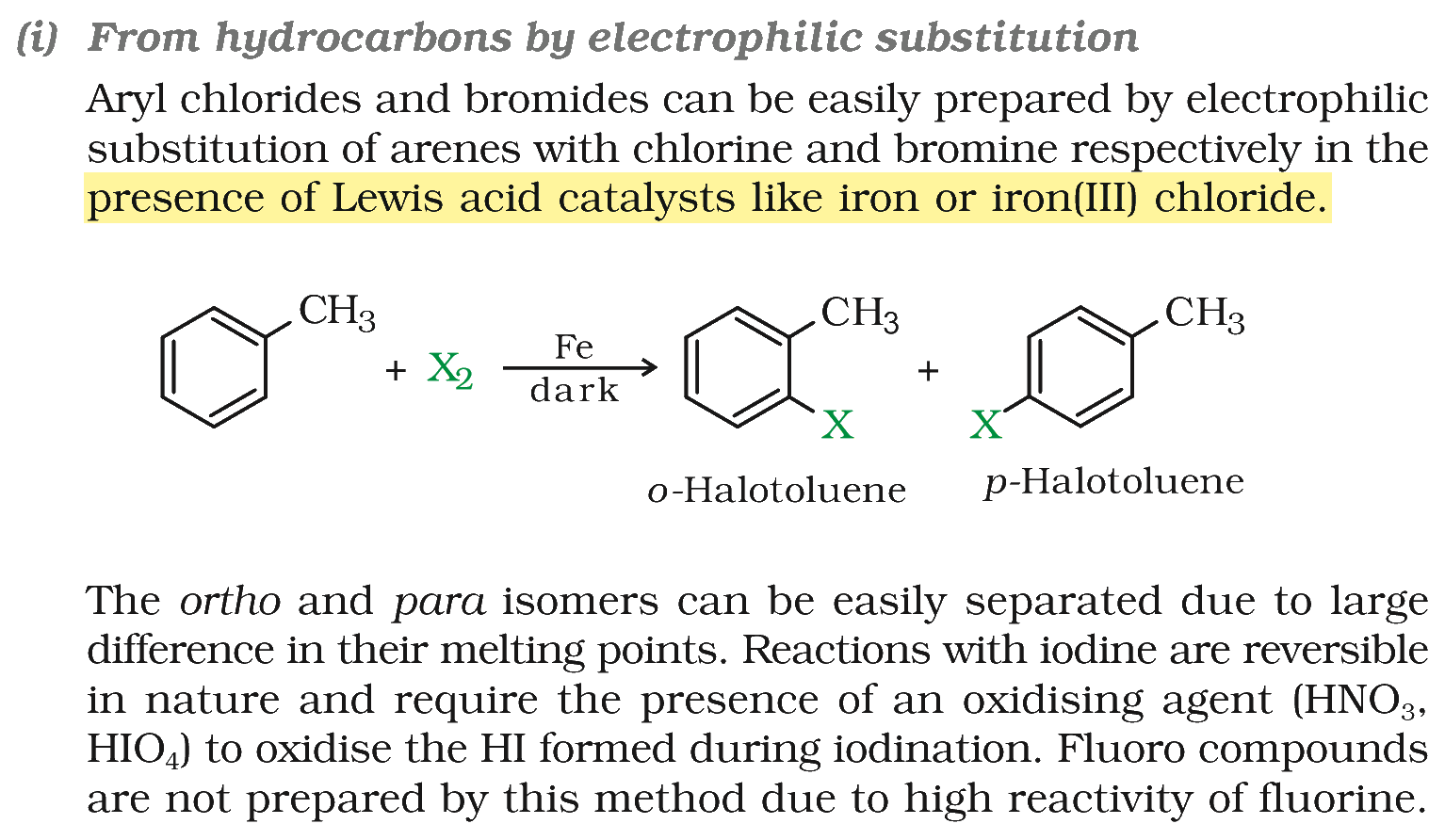
The conversion puts a chlorine atom on the benzene ring of toluene, at the para position; the \( \ce{CH3} \) group is unchanged. This is electrophilic substitution, which needs a Lewis acid catalyst. \( \ce{FeCl3} \) polarises \( \ce{Cl2} \) and generates the electrophile \( \ce{Cl^{+}} \); the \( \ce{CH3} \) group is ortho/para directing, so o- and p-chlorotoluene are formed:
\( \ce{Cl2 + FeCl3 -> Cl+ + [FeCl4]^-} \)
\( \ce{C6H5CH3 + Cl2} \xrightarrow[\text{dark}]{\ce{FeCl3}} \text{o- and p-}\ce{ClC6H4CH3 + HCl} \)
Why the other options are incorrect
Option (1) \(SO_2Cl_2\) — Incorrect. Sulphuryl chloride (with light or a peroxide) chlorinates by a free-radical path, which attacks the \( \ce{CH3} \) side chain and gives benzyl chloride, \( \ce{C6H5CH2Cl} \).
Option (2) N-Chlorosuccinimide — Incorrect. NCS is used for free-radical chlorination at allylic and benzylic positions, again the side chain, not the ring.
Option (4) \(SOCl_2\) — Incorrect. Thionyl chloride converts alcohols into alkyl chlorides (R–OH → R–Cl + \( \ce{SO2} \) + HCl); it does not substitute an aromatic C–H.
NCERT (2026-27 edition):
From Hydrocarbons by Electrophilic Substitution