In humans, the fertilization takes place at -
Answer & explanation
Correct answer: option 4
The correct answer is Option (4) → Ampullary region of fallopian tube
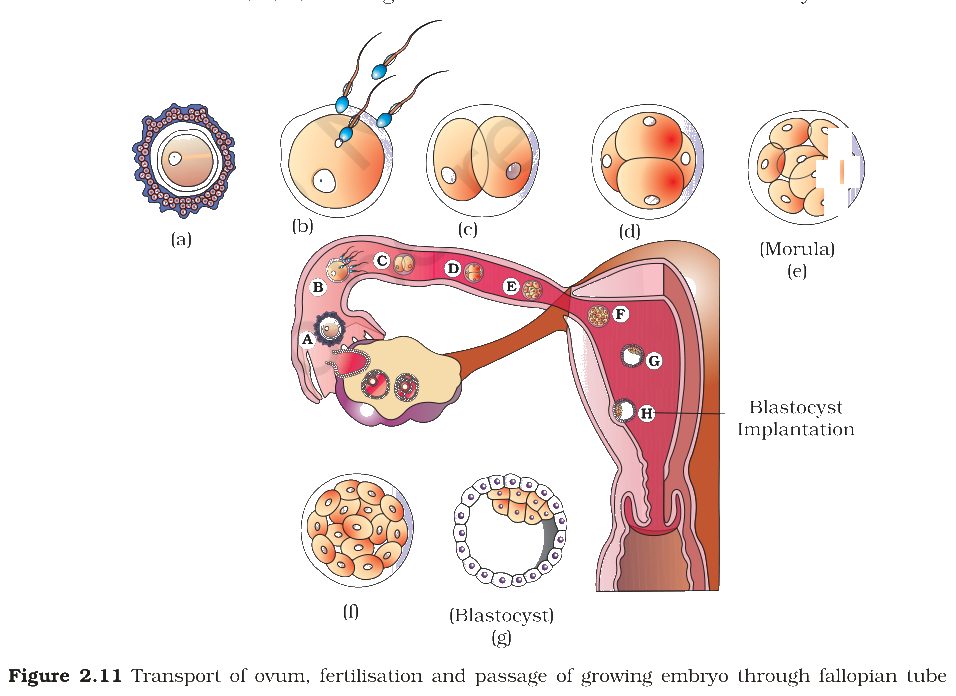
The fallopian tube (oviduct) has three parts: the funnel-shaped infundibulum near the ovary, the wider ampulla in the middle, and the narrow isthmus that joins the uterus.
Option (1) Cervix — Incorrect. The cervix is the narrow lower part of the uterus that opens into the vagina. Sperms pass through it on their way up, but the ovum is not there to meet them.
Option (2) Isthmus region of fallopian tube — Incorrect. The isthmus is the last, narrow part of the tube. The dividing embryo later passes through it on its way to the uterus.
Option (3) Infundibulum region of fallopian tube — Incorrect. The infundibulum has finger-like fimbriae. They collect the ovum after ovulation and pass it on into the tube.
Option (4) Ampullary region of fallopian tube — Correct. The ovum moves from the infundibulum into the ampulla, and the sperms swim up to it. Fertilisation happens only if the ovum and the sperms reach this region at the same time.
Note: A similar question was also asked in CUET (UG) 2025 on 30-05-2025 (Slot 1).
NCERT Extract:
Fertilisation and Implantation – “… During copulation (coitus) semen is released by the penis into the vagina (insemination). The motile sperms swim rapidly, pass through the cervix, enter into the uterus and finally reach the ampullary region of the fallopian tube (Figure 2.11b). The ovum released by the ovary is also transported to the ampullary region where fertilisation takes place. Fertilisation can only occur if the ovum and sperms are transported simultaneously to the ampullary region. This is the reason why not all copulations lead to fertilisation and pregnancy.”