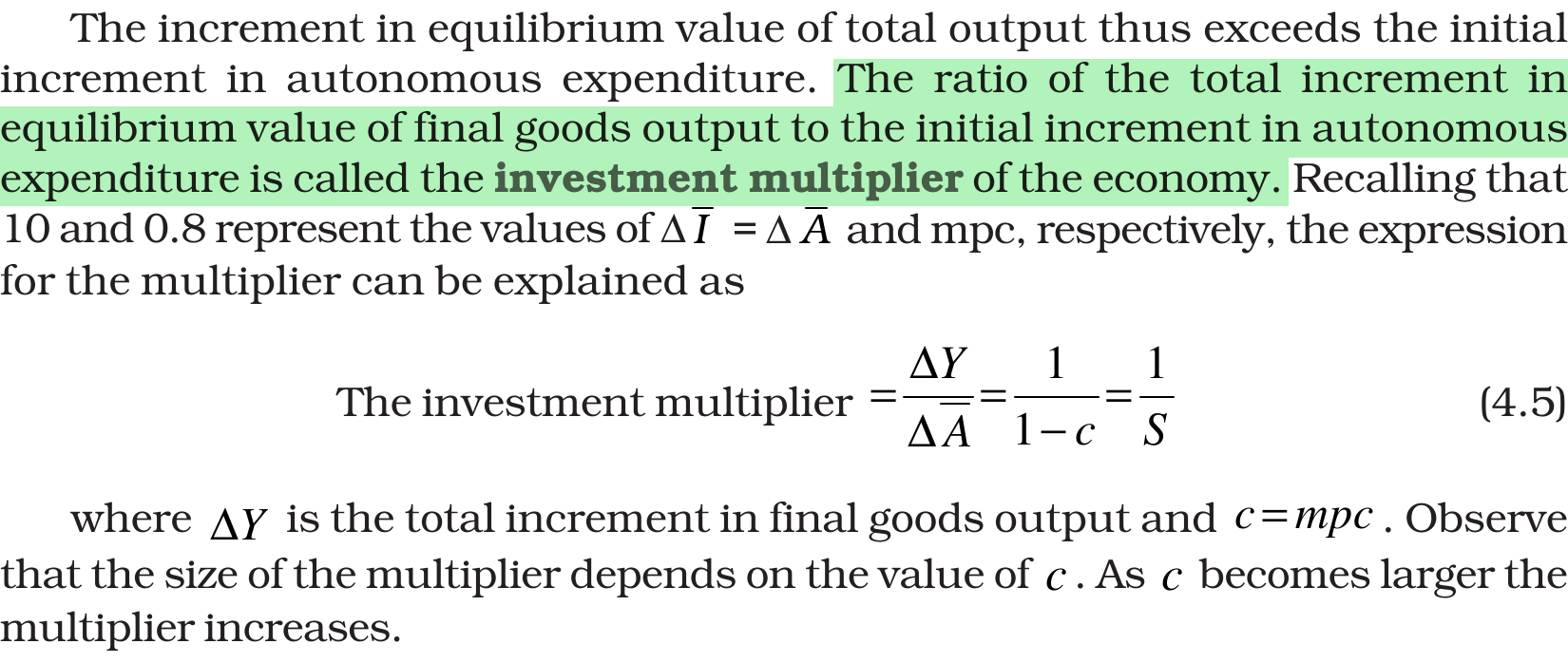
The ratio of the total increment in equilibrium value of final goods output to the initial increment in autonomous investment expenditure is known as?
Answer & explanation
Correct answer: option 1
The correct answer is Option (1) → Investment Multiplier.
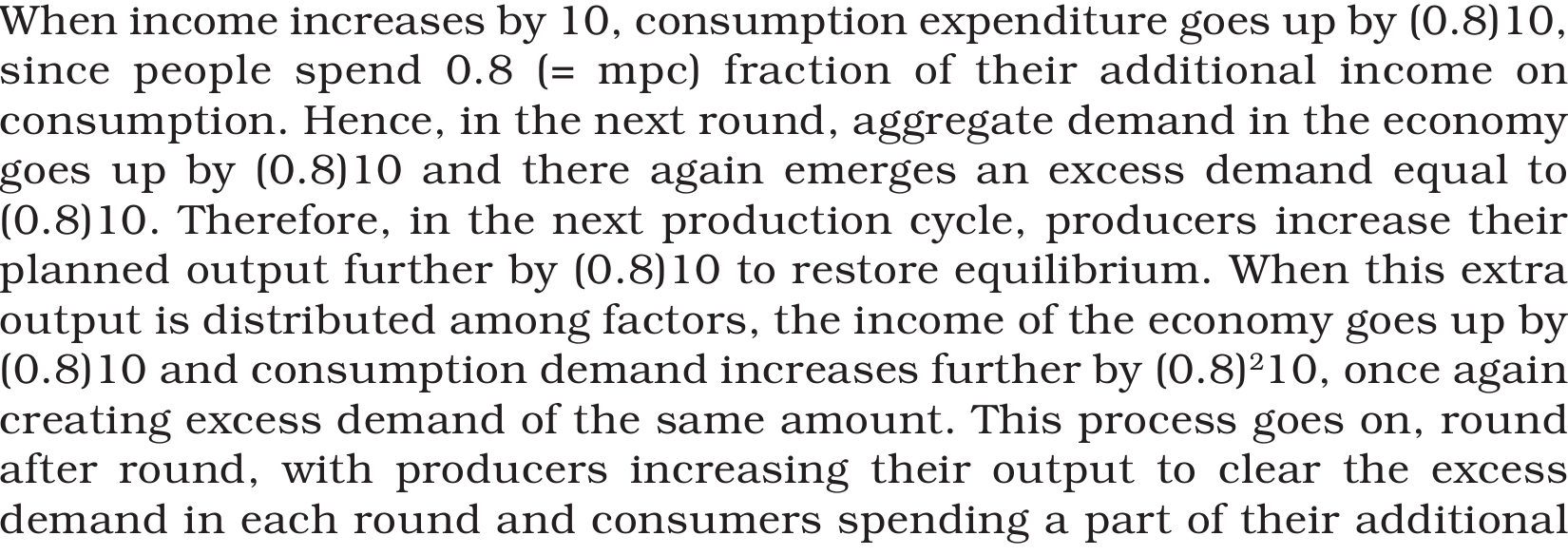
The total rise in equilibrium output divided by the first rise in autonomous investment is the investment multiplier. Autonomous investment is investment that does not depend on income.
Suppose firms spend Rs. 10 crore more on investment. That money becomes someone’s income. Part of it is spent and becomes another person’s income, round after round. So output rises by more than the first Rs. 10 crore.
Investment multiplier = \( \Delta Y/\Delta \bar{A} \) = 1/(1 − c)
Here ΔY is the total rise in output and \( \Delta \bar{A} \) is the first rise in autonomous investment. c is the marginal propensity to consume, the part of extra income that is spent. If c = 0.8, the multiplier is 5, and the Rs. 10 crore raises output by Rs. 50 crore.
Note: A same/similar question was asked in CUET (UG) in the papers below.
| 2026 | 2025 | 2024 | 2023 | 2022 |
| 13-05 S1* 21-05 S1* | 13-05 S2* 27-05 S2* 29-05 S2 30-05 S2* | – | 29-05 S1* 22-06 S3* | – |
* A similar question.
NCERT (2026-27): Introductory Macroeconomics — Chapter 4: Determination of Income and Employment
|