
CUETMOCK
  • Pricing
  • Mentors
Log inStart freeStart free mocks→

First test, then trust

Try a free CUET mock test.

Join 5,00,000+ students who rehearsed exam day on the exact NTA screen before sitting CUET. On the web and on Android.

Start free mocks →Get the Android app
CUETMOCK

India's #1 CUET Mock Test Platform. Original NCERT-based questions on the exact NTA exam screen — trusted by 5,00,000+ students since CUET 2022.

Get it onGoogle PlayScan to download the CUETMOCK app

Mock tests

  • CUET mock test series
  • Browse all papers
  • Commerce mocks
  • Humanities (Arts) mocks
  • Science mocks
  • Languages & GAT mocks
  • Free practice questions
  • Pricing

Resources

  • CUET exam guide
  • CUET syllabus
  • Universities accepting CUET
  • Expert blogs
  • News & notifications
  • Webinars & counselling
  • CUET score calculator
  • How we estimate your rank
  • FAQs

Company

  • About us
  • Our leadership & team
  • Our toppers
  • Mentors
  • For schools
  • Contact us
  • Terms
  • Privacy
  • Refund policy

Talk to us

+91 7696 6630 56info@cuetmock.comWhatsApp us

Our other platforms

  • JEE Mock — For IIT-JEE aspirants
  • NEET Mock — For NEET aspirants

Newsletter

Exam updates, study material and offers — no spam.

© 2026 NYC Ventures Pvt. Ltd.

701-702, Royal Business Park, Zirakpur, Punjab - 140603

  • Terms of use
  • Privacy policy
  • Refund policy
  • Contact us

iCUETMOCK is an independent preparation platform, not affiliated with the National Testing Agency (NTA). Always check exam details on the official NTA website.

  • Home
  • Mock tests
  • CUET guide
  • Pricing
  • Log in
Home/Practice questions/General Aptitude Test
General Aptitude TestVerbal ReasoningSyllogism

Accept every statement below as true, whatever the real world says. W…

Accept every statement below as true, whatever the real world says. Which of the conclusions must then be true?

Statements:
1. No demand is a pencil.
2. All demands are claims.

Conclusions:
I. No pencil is a claim.
II. All claims are demands.

Answer & explanation+

Correct answer: option 3

The correct answer is Option (3) → Neither conclusion I nor conclusion II follows

A conclusion follows only if it is true in every diagram that fits the statements. One diagram in which a conclusion is false is enough to reject it.

  • “All demands are claims”: the circle of demands lies inside the circle of claims

  • “No demand is a pencil”: the circle of pencils keeps away from the demands, but it may still overlap the claims outside the demands
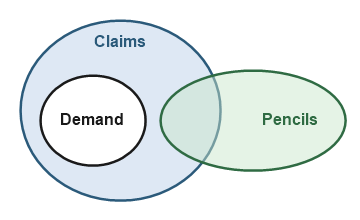
Figure for the solution

  • Conclusion I: No pencil is a claim. — Does not follow. In the diagram the pencil circle overlaps the claims outside the demands, so some pencils are claims.

  • Conclusion II: All claims are demands. — Does not follow. “All demands are claims” cannot be reversed: the claims outside the demand circle are not demands.

The two conclusions do not cover every case between them (in the diagram both are false), so “either I or II” does not apply.

Advertisement

Practise more on Verbal Reasoning

Chapter-wise mocks on the real NTA exam screen, with solutions and your rank. Your first mocks are free.

Start free mocks →

Advertisement

Next questions

  1. Identity the type, purpose and example of the merger discuss below. "Merger takes place between two companies that deal is the same product…Entrepreneurship · Enterprise growth Strategies
  2. Which one of the following was part of the global war on terrorism by the U.S.?Political Science · Contemporary World Politics: US Hegemony in World Politics
  3. Let f(x) = discuss maxima and minimaMaths. Section B1 · Applications of Derivatives
  4. The word communication has been derived from the _____ word 'communis'.Business Studies · Directing
  5. Given below are some stages of human evolution. Arrange them in correct sequence (Past to Recent)(A) Homo habilis(B) Homo sapiens(C) Homo n…Biology · Evolution
  6. To prove theory of mutation, Hugo de Vries used _________ plant.Biology · Evolution
  7. By selling an article for Rs.33,000 a man gains 10%. To get a profit of 20%, he has to sell it for:General Aptitude Test · Numerical Ability
  8. Who was called the Glacier Man?English · Comprehension - (Narrative / Factual)
  9. Match the following options in List 1 correctly with those in List 2: List 1 List 2 (a) Khwaja Muinuddin (i) Malik Muhammad Jayasi (b) Abu'…History · Medieval India: Bhakti Sufi Traditions
  10. Many countries have reached an agreement to reduce the emission of greenhouse gases. Which of the following is one such agreement?General Aptitude Test · General Knowledge