
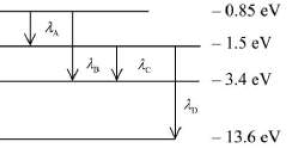
The energy diagram of hydrogen atom is given below. Arrange the wavelengths corresponding to different emissions in increasing order.
Answer & explanation
Correct answer: option 3
The correct answer is Option (3) → \( \lambda_A \gt \lambda_C \gt \lambda_B \gt \lambda_D \)
When the electron falls from a level \( E_i \) to a lower level \( E_f \), a photon of energy \( \Delta E = E_i - E_f \) is emitted and its wavelength is \( \lambda = hc/\Delta E \). A larger energy gap gives a shorter wavelength.
Reading the arrows from the energy levels in the figure (−0.85 eV, −1.5 eV, −3.4 eV, −13.6 eV):
\( \lambda_A \): \( -0.85 \rightarrow -1.5 \), \( \Delta E_A = 0.65\,\mathrm{eV} \)
\( \lambda_B \): \( -0.85 \rightarrow -3.4 \), \( \Delta E_B = 2.55\,\mathrm{eV} \)
\( \lambda_C \): \( -1.5 \rightarrow -3.4 \), \( \Delta E_C = 1.9\,\mathrm{eV} \)
\( \lambda_D \): \( -1.5 \rightarrow -13.6 \), \( \Delta E_D = 12.1\,\mathrm{eV} \)
The energy gaps are in the order \( \Delta E_A \lt \Delta E_C \lt \Delta E_B \lt \Delta E_D \), so the wavelengths are in the reverse order:
\( \lambda_A \gt \lambda_C \gt \lambda_B \gt \lambda_D \)
Written from the largest to the smallest, this is the order given in Option (3).
Note: It seems that there is a mistake in the original NTA paper, which asks for the wavelengths in “increasing order” although every option lists them with > signs, that is, from the largest to the smallest. The question has been taken as asking for the decreasing order. In the increasing order the wavelengths are \( \lambda_D \lt \lambda_B \lt \lambda_C \lt \lambda_A \), which is not given in any option.