CUETMOCK
  • Pricing
  • Mentors
Log inStart freeStart free mocks→

First test, then trust

Try a free CUET mock test.

Join 5,00,000+ students who rehearsed exam day on the exact NTA screen before sitting CUET. On the web and on Android.

Start free mocks →Get the Android app
CUETMOCK

India's #1 CUET Mock Test Platform. Original NCERT-based questions on the exact NTA exam screen — trusted by 5,00,000+ students since CUET 2022.

Get it onGoogle PlayScan to download the CUETMOCK app

Mock tests

  • CUET mock test series
  • Browse all papers
  • Commerce mocks
  • Humanities (Arts) mocks
  • Science mocks
  • Languages & GAT mocks
  • Free practice questions
  • Pricing

Resources

  • CUET exam guide
  • CUET syllabus
  • Universities accepting CUET
  • Expert blogs
  • News & notifications
  • Webinars & counselling
  • CUET score calculator
  • How we estimate your rank
  • FAQs

Company

  • About us
  • Our leadership & team
  • Our toppers
  • Mentors
  • For schools
  • Contact us
  • Terms
  • Privacy
  • Refund policy

Talk to us

+91 7696 6630 56info@cuetmock.comWhatsApp us

Our other platforms

  • JEE Mock — For IIT-JEE aspirants
  • NEET Mock — For NEET aspirants

Newsletter

Exam updates, study material and offers — no spam.

© 2026 NYC Ventures Pvt. Ltd.

701-702, Royal Business Park, Zirakpur, Punjab - 140603

  • Terms of use
  • Privacy policy
  • Refund policy
  • Contact us

iCUETMOCK is an independent preparation platform, not affiliated with the National Testing Agency (NTA). Always check exam details on the official NTA website.

  • Home
  • Mock tests
  • CUET guide
  • Pricing
  • Log in
Home/Practice questions/Economics
EconomicsMacro Economics: Money and Banking

High-powered money comprises of:

High-powered money comprises of:

Answer & explanation+

Correct answer: option 1

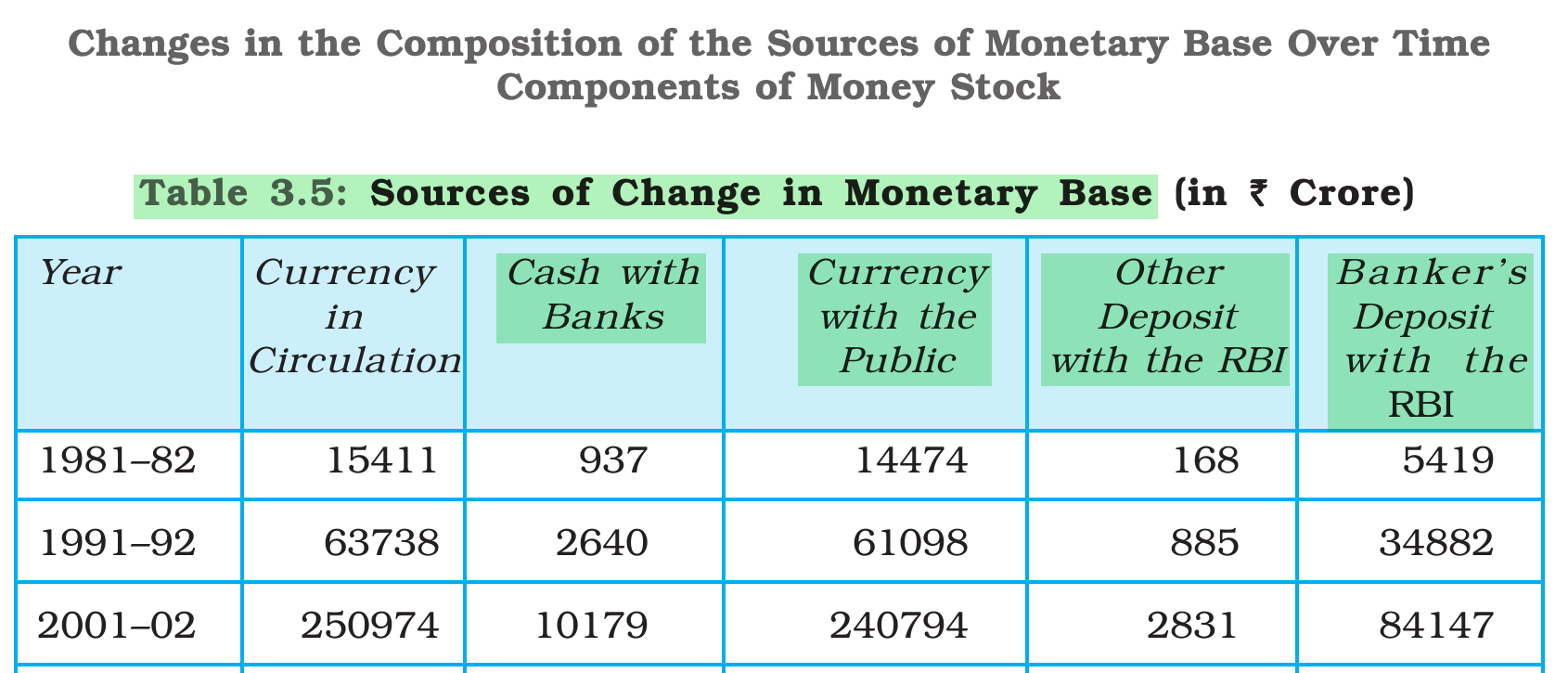
The correct answer is Option (1) → Notes and coins in circulation with Public and Vault cash of Commercial Banks and deposits held by Government and Commercial Banks with RBI.

High-powered money is the money issued by the central bank, which banks use as the base for creating credit. It is also called reserve money or the monetary base. Vault cash is the cash that banks keep in their own safes.

  • Option (1) Notes and coins in circulation with Public and Vault cash of Commercial Banks and deposits held by Government and Commercial Banks with RBI. — Correct. It has the currency held by the public and by banks, and also the deposits kept with the RBI.

  • Option (2) Notes and coins in circulation with Public and deposits held by Government. — Incorrect. It leaves out what the banks hold: their vault cash and their deposits with the RBI.

  • Option (3) Notes and coins in circulation with Public and demand deposits held by Public with Commercial Banks. — Incorrect. This is M1, the narrow money supply. Demand deposits are created by commercial banks and are payable on demand. So they are not money issued by the central bank.

  • Option (4) Notes and Vault cash of Commercial Banks. — Incorrect. It leaves out the coins and all the deposits with the RBI.

NCERT (2026-27): “Central bank Central Bank is a very important institution in a modern economy. Almost every country has one central bank. India got its central bank in 1935. Its name is the ‘Reserve Bank of India’. Central bank has several important functions. It issues the currency of the country. It controls money supply of the country through various methods, like bank rate, open market operations and variations in reserve ratios. It acts as a banker to the government. It is the custodian of the foreign exchange reserves of the economy. It also acts as a bank to the banking system, which is discussed in detail later. From the point of view of money supply, we need to focus on its function of issuing currency. This currency issued by the central bank can be held by the public or by the commercial banks, and is called the ‘high-powered money’ or ‘reserve money’ or ‘monetary base’ as it acts as a basis for credit creation.…

Legal Definitions: Narrow and Broad Money … M1 = CU + DD… where, CU is currency (notes plus coins) held by the public and DD is net demand deposits held by commercial banks.…”

NCERT extract

Advertisement

Practise more on Macro Economics: Money and Banking

Chapter-wise mocks on the real NTA exam screen, with solutions and your rank. Your first mocks are free.

Start free mocks →

Advertisement

Next questions

  1. Which one of the following is the correct sequence in the decreasing order of contribution of different sources to the gross domestic produ…General Aptitude Test · General Knowledge
  2. Given that 1+2+3+…+9=45 , find the value of 11+12+13+…+19 .General Aptitude Test · Numerical Ability
  3. Arrange the following commodities in descending order according to their share in India's import (2021-2022)? (A) Petroleum, oil and Lubric…Geography · India-People and Economy: International Trade
  4. Match Column I with Column II: Column I Column II A. Epiphytes 1. Cattle egret B. Grazing cattle 2. Orchid on mango tree C. Sea anemone 3.…Biology · Organisms and Populations
  5. What is the value of ( 1+ tanθ - secθ) ( 1 + cot θ+ cosec θ) ?General Aptitude Test · Quantitative Reasoning
  6. उद्गम की दृष्टि से निम्नलिखित शब्दों को तत्सम, तद्भव, देशज और विदेशज के क्रम में व्यवस्थित कीजिये -A. गाँवB. क्षेत्रC. गाड़ीD. दुकानHindi · व्याकरण - सशब्द विचार
  7. Given below are the steps of the polymerase chain reaction Select the option that correctly mentions the sequence in which they occur.Biology · Biotechnology -Principles and Processes
  8. A leading manufacturer of athletic shoes merges with a soft drink firm. This is an example of which type of merger?Entrepreneurship · Enterprise growth Strategies
  9. Solids like fats, grease and oil that float on top of liquid wastewater is called ________ .General Aptitude Test · General Knowledge
  10. What does this sculpture from Amaravati depict about Buddha's life?History · Ancient India: Thinkers, Beliefs and Buildings