
Which of the following alcohols undergoes dehydration at a faster rate ?
Answer & explanation
Correct answer: option 1
The correct answer is Option (1) → 2-Methylpropan-2-ol
Alcohols lose water when heated with a protic acid, giving alkenes. For secondary and tertiary alcohols the reaction goes through a carbocation:
The –OH group is protonated.
Water leaves and a carbocation forms; this is the slow step.
A proton is lost from the neighbouring carbon, giving the alkene.
Since the slow step forms a carbocation, the alcohol that gives the most stable carbocation dehydrates fastest.
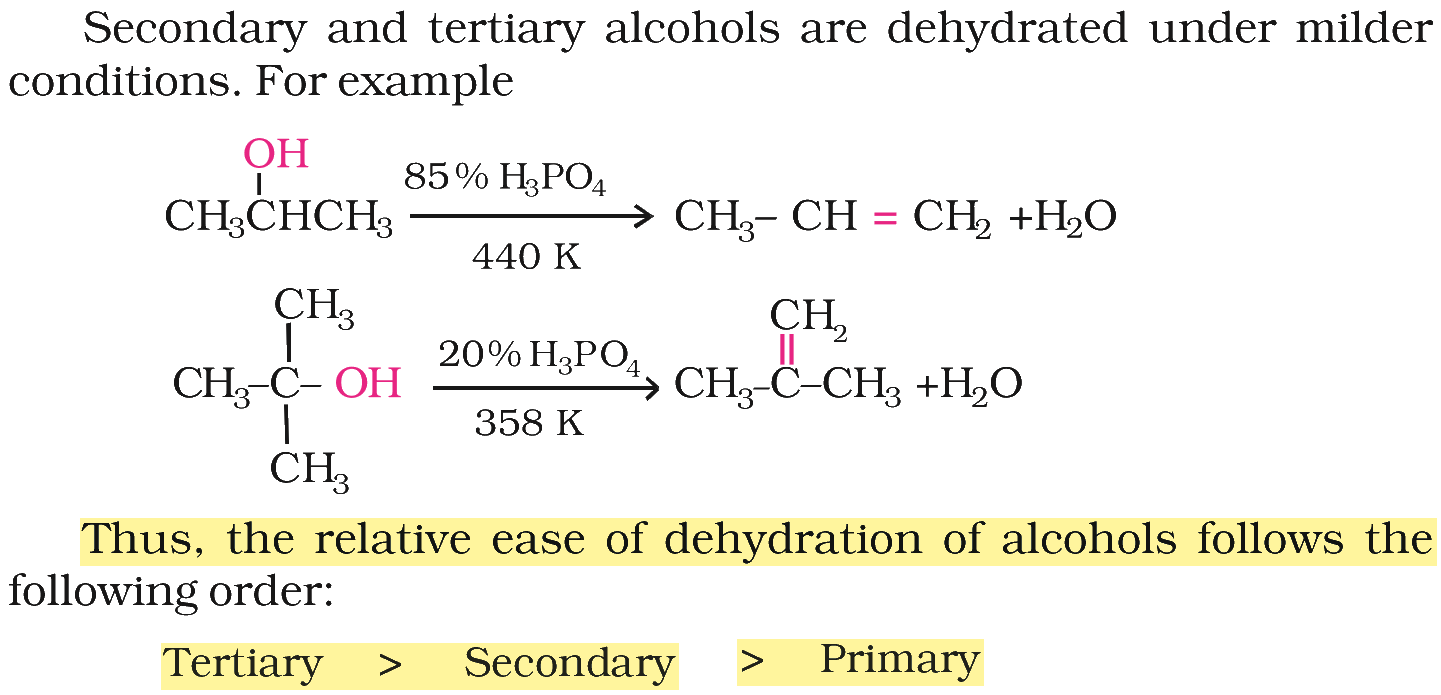
2-Methylpropan-2-ol (tert-butyl alcohol), \( \ce{(CH3)3COH} \), is the only tertiary alcohol given, so it dehydrates at the fastest rate:
\( \displaystyle \ce{(CH3)3C-OH} \xrightarrow[\text{358 K}]{\ce{H3PO4}} \ce{(CH3)2C=CH2 + H2O} \)
Why the other options are incorrect
Option (2) Ethanol — Incorrect. A primary alcohol; it needs concentrated \( \ce{H2SO4} \) at 443 K.
Option (3) Propanol — Incorrect. A primary alcohol; like ethanol, it dehydrates slowest.
Option (4) Butanol — Incorrect. Butan-1-ol is a primary alcohol; even butan-2-ol is only secondary, so both are slower than a tertiary alcohol.
NCERT (2026-27 edition):
Dehydration – …
Note: The same/similar question has been asked in different years by NTA as per the details given below:
| 2026 | 2025 | 2024 | 2023 | 2022 |
|---|---|---|---|---|
| 26-05 S2 24-05 S2 | – | – | – | – |