
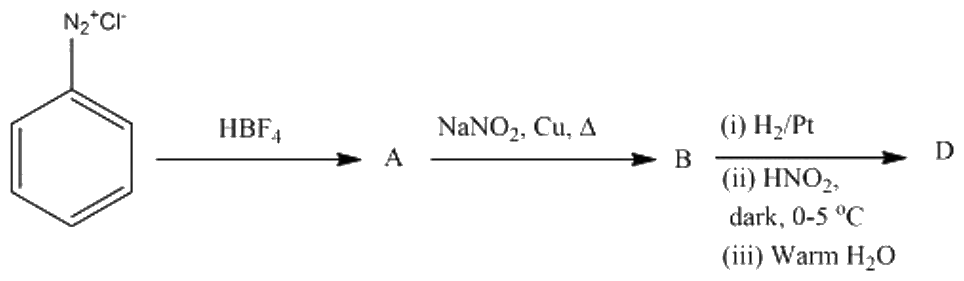
Identify the final product (D) in the following reaction.
Answer & explanation
Correct answer: option 2
The correct answer is Option (2) → Phenol
Arenediazonium salts are useful because the –\( \ce{N2^{+}} \) group can be replaced by many other groups, while \( \ce{N2} \) escapes as a gas. Following the sequence step by step:
A: with fluoroboric acid, the chloride is converted into insoluble benzenediazonium fluoroborate.
\( \displaystyle \ce{C6H5N2^+Cl^- + HBF4 -> C6H5N2^+BF4^- + HCl} \)
B: the fluoroborate heated with aqueous NaNO2 and copper replaces –\( \ce{N2^{+}} \) by –\( \ce{NO2} \), giving nitrobenzene.
\( \displaystyle \ce{C6H5N2^+BF4^-} \xrightarrow{\ce{NaNO2},\ \ce{Cu},\ \Delta} \ce{C6H5NO2 + N2 + NaBF4} \)
(i) H2/Pt: nitrobenzene is reduced to aniline.
\( \displaystyle \ce{C6H5NO2 + 3H2} \xrightarrow{\ce{Pt}} \ce{C6H5NH2 + 2H2O} \)
(ii) HNO2, 0–5 °C: aniline is diazotised back to the benzenediazonium ion.
\( \displaystyle \ce{C6H5NH2 + HNO2 + HCl} \xrightarrow{0-5\ ^{\circ}\mathrm{C}} \ce{C6H5N2^+Cl^- + 2H2O} \)
(iii) Warm H2O: the diazonium ion is hydrolysed to phenol, so D is phenol.
\( \displaystyle \ce{C6H5N2^+ + H2O} \xrightarrow{\text{warm}} \ce{C6H5OH + N2 + H^+} \)
So the final product D is phenol.
Why the other options are incorrect
Option (1) Nitrobenzene — Incorrect. It is the intermediate B; it is reduced in the next step.
Option (3) Aniline — Incorrect. It is formed in step (i) but is diazotised in step (ii).
Option (4) Benzene — Incorrect. It would be formed only if the diazonium salt were treated with a reducing agent such as H3PO2 or ethanol, not with warm water.