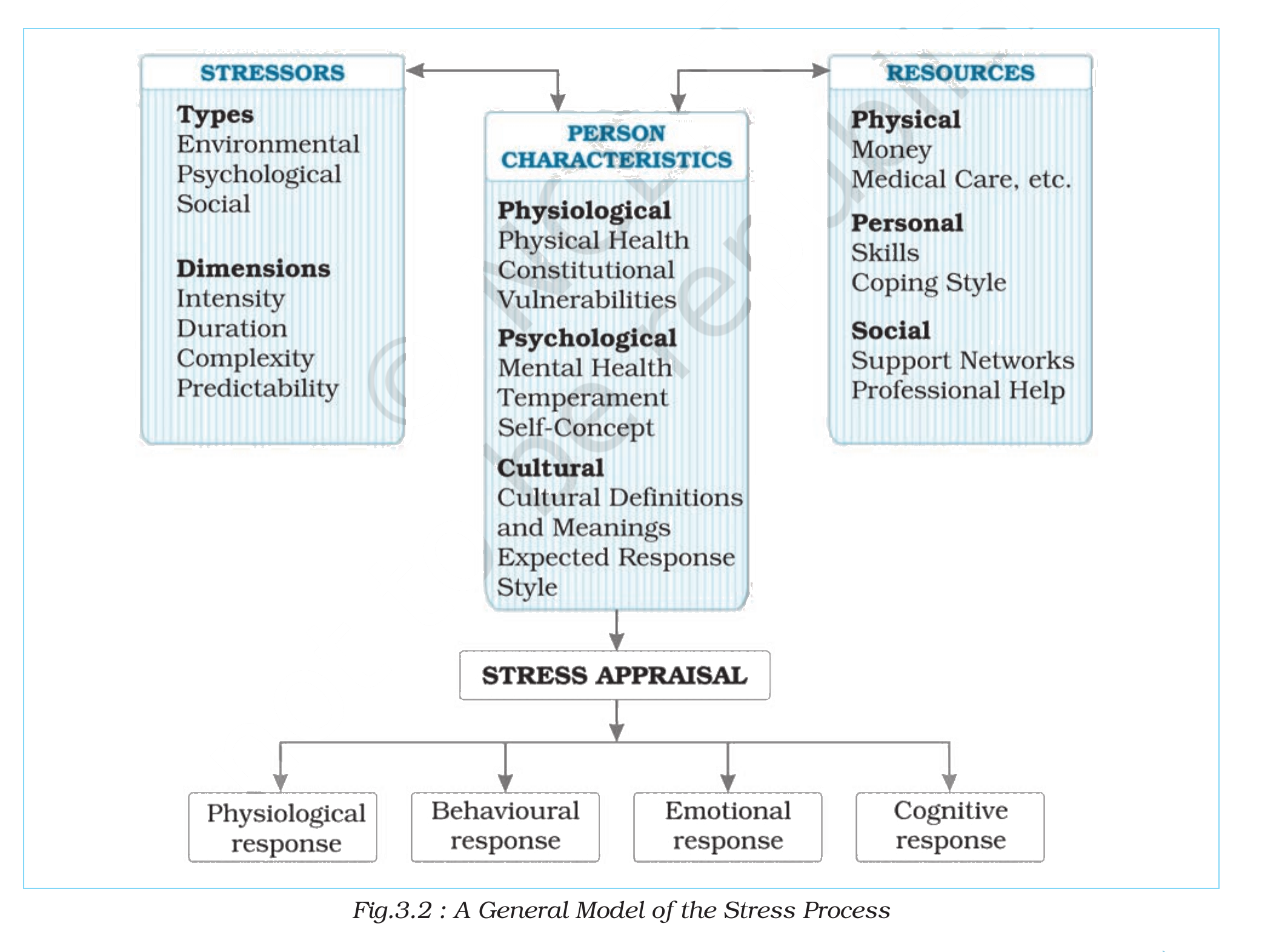
Which of the following is NOT considered as a dimension of stress?
Answer & explanation
Correct answer: option 1
The correct answer is Option (1) → Controllability
Option (1) Controllability — Not a dimension of stress (Correct). Stresses vary on four dimensions only: intensity, duration, complexity and predictability. Controllability belongs elsewhere: a person’s beliefs about the causes or controllability of an event are part of the cognitive response to stress. It is how the person reads the event, not a way in which stresses themselves differ.
Option (2) Complexity — A dimension of stress (Incorrect). A stress may be less complex or more complex; more complex stresses have worse effects.
Option (3) Predictability — A dimension of stress (Incorrect). A stress may be expected or unexpected; unanticipated stresses hurt more.
Option (4) Duration — A dimension of stress (Incorrect). A stress may be short-term or long-term; prolonged or chronic stress has more negative consequences.
NCERT (2025-26): “Nature of Stress … Cognitive responses include beliefs about the harm or threat an event poses and beliefs about its causes or controllability. These include responses such as inability to concentrate, and intrusive, repetitive or morbid thoughts. As indicated in Figure 3.2, the stresses which people experience also vary in terms of intensity (low intensity vs. high intensity), duration (short-term vs. long-term), complexity (less complex vs. more complex) and predictability (unexpected vs. predictable). The outcome of stress depends on the position of a particular stressful experience along these dimensions. Usually more intense, prolonged or chronic, complex and unanticipated stresses have more negative consequences than have less intense, short-term, less complex and expected stresses.…”
|