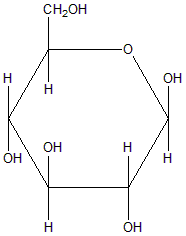
Identify the compound whose Haworth structure is given below.
Answer & explanation
Correct answer: option 4
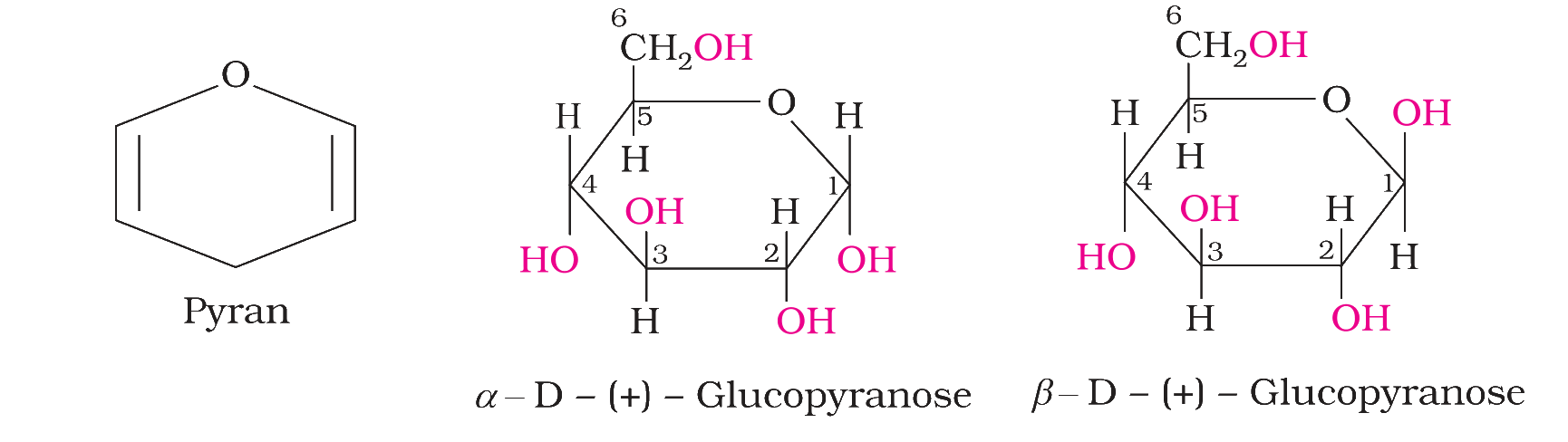
The correct answer is Option (4) → β-D-(+)-glucopyranose
In a Haworth structure the ring size gives pyranose or furanose, and the –OH group on the anomeric carbon C1 gives α or β.
Ring size: the ring has five carbon atoms and one oxygen atom, a six membered ring, so it is a pyranose, not a furanose (five membered ring).
Configuration at C2, C3, C4: –OH down at C2, up at C3 and down at C4, with \( \ce{CH2OH} \) above the ring at C5: the pattern of D-glucose.
Anomeric carbon C1: the –OH group points up, on the same side as the \( \ce{CH2OH} \) group, so this is the β-anomer. In the α-anomer this –OH points down.
NCERT (2026-27 edition):
10.1.2.1 Glucose – “The two cyclic hemiacetal forms of glucose differ only in the configuration of the hydroxyl group at C1, called anomeric carbon (the aldehyde carbon before cyclisation). Such isomers, i.e., α-form and β-form, are called anomers. The six membered cyclic structure of glucose is called pyranose structure (α– or β–), in analogy with pyran. Pyran is a cyclic organic compound with one oxygen atom and five carbon atoms in the ring. The cyclic structure of glucose is more correctly represented by Haworth structure as given below.”