
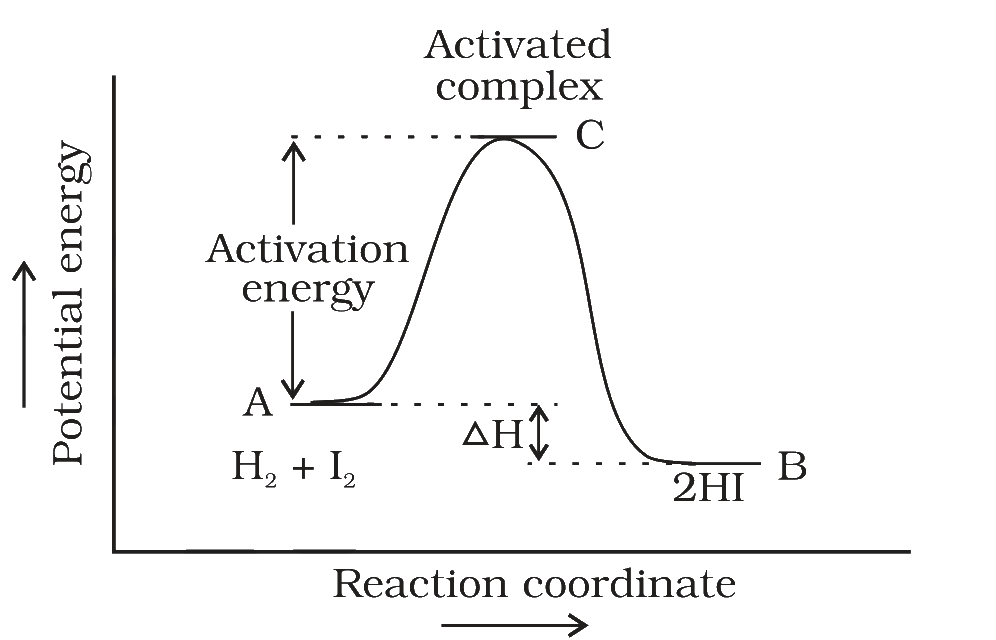
The figure shows the plot of potential energy against reaction coordinate for the reaction \( \ce{H2(g) + I2(g) -> 2HI(g)} \).
Which of the following is correct about this reaction?
Answer & explanation
Correct answer: option 2
The correct answer is Option (2) → The activated complex C is an unstable intermediate that exists for a very short time before it breaks up to form 2HI.
The plot follows the energy as H2 and I2 (A) change into 2HI (B). On the way they must pass over a hump, whose top is the activated complex (C).
A molecule of H2 and a molecule of I2 collide to form C, the point of highest energy on the path.
It is an unstable intermediate: it lasts for a very short time and then breaks up into two molecules of HI.
Why the other options are incorrect
Option (1) Energy is absorbed when the activated complex C breaks up to form the products B. — Incorrect. The curve falls from C to B, so energy is released, not absorbed, when the complex breaks up into the products.
Option (3) The activation energy of the reaction is the energy gap between the activated complex C and the products B. — Incorrect. The activation energy arrow in the figure runs from the reactants A up to C: it is the energy needed to form the activated complex from the reactants, not the gap down to the products.
Option (4) The enthalpy change, ΔH, of the reaction depends on the energy of the activated complex C. — Incorrect. ΔH is the gap between A and B only. It depends on the nature of the reactants and the products; the height of C sets the activation energy, not ΔH.
NCERT (2026-27 edition):
3.4 Temperature Dependence of the Rate of a Reaction – “According to Arrhenius, this reaction can take place only when a molecule of hydrogen and a molecule of iodine collide to form an unstable intermediate … It exists for a very short time and then breaks up to form two molecules of hydrogen iodide.”
“The energy required to form this intermediate, called activated complex (C), is known as activation energy (Ea).”
“Some energy is released when the complex decomposes to form products. So, the final enthalpy of the reaction depends upon the nature of reactants and products.”
Fig. 3.7: Diagram showing plot of potential energy vs reaction coordinate