
CUETMOCK
  • Pricing
  • Mentors
Log inStart freeStart free mocks→

First test, then trust

Try a free CUET mock test.

Join 5,00,000+ students who rehearsed exam day on the exact NTA screen before sitting CUET. On the web and on Android.

Start free mocks →Get the Android app
CUETMOCK

India's #1 CUET Mock Test Platform. Original NCERT-based questions on the exact NTA exam screen — trusted by 5,00,000+ students since CUET 2022.

Get it onGoogle PlayScan to download the CUETMOCK app

Mock tests

  • CUET mock test series
  • Browse all papers
  • Commerce mocks
  • Humanities (Arts) mocks
  • Science mocks
  • Languages & GAT mocks
  • Free practice questions
  • Pricing

Resources

  • CUET exam guide
  • CUET syllabus
  • Universities accepting CUET
  • Expert blogs
  • News & notifications
  • Webinars & counselling
  • CUET score calculator
  • How we estimate your rank
  • FAQs

Company

  • About us
  • Our leadership & team
  • Our toppers
  • Mentors
  • For schools
  • Contact us
  • Terms
  • Privacy
  • Refund policy

Talk to us

+91 7696 6630 56info@cuetmock.comWhatsApp us

Our other platforms

  • JEE Mock — For IIT-JEE aspirants
  • NEET Mock — For NEET aspirants

Newsletter

Exam updates, study material and offers — no spam.

© 2026 NYC Ventures Pvt. Ltd.

701-702, Royal Business Park, Zirakpur, Punjab - 140603

  • Terms of use
  • Privacy policy
  • Refund policy
  • Contact us

iCUETMOCK is an independent preparation platform, not affiliated with the National Testing Agency (NTA). Always check exam details on the official NTA website.

  • Home
  • Mock tests
  • CUET guide
  • Pricing
  • Log in
Home/Practice questions/Physics
PhysicsCurrent Electricity

Current through the galvanometer in the circuit given below is
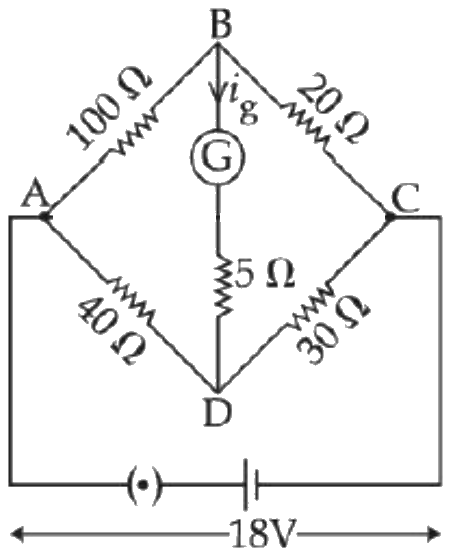
Current through the galvanometer in the circuit given below is

Figure for the question

Answer & explanation+

Correct answer: option 1

The correct answer is Option (1) → 121 mA

The 18 V cell is across A and C, and the galvanometer with the \( 5\,\Omega \) resistor is the branch BD (cell and galvanometer taken as ideal). The quickest route is Thevenin's theorem across B and D.

Remove branch BD and take C at zero potential, so A is at 18 V. Branches ABC (\( 100\,\Omega \) and \( 20\,\Omega \)) and ADC (\( 40\,\Omega \) and \( 30\,\Omega \)) are potential dividers:

    \( \displaystyle V_B = 18\times\frac{20}{100 + 20} = 3\,\mathrm{V} \)

    \( \displaystyle V_D = 18\times\frac{30}{40 + 30} = 7.71\,\mathrm{V} \)

    \( \displaystyle V_{\mathrm{th}} = V_D - V_B = 7.71 - 3 = 4.71\,\mathrm{V} \)

With the cell shorted, the \( 100\,\Omega \) and \( 20\,\Omega \) in parallel are in series with the \( 40\,\Omega \) and \( 30\,\Omega \) in parallel:

    \( \displaystyle R_{\mathrm{th}} = \frac{100\times20}{120} + \frac{40\times30}{70} = 16.67 + 17.14 = 33.81\,\Omega \)

Reconnecting branch BD (\( 5\,\Omega \)):

    \( \displaystyle i_g = \frac{V_{\mathrm{th}}}{R_{\mathrm{th}} + 5} = \frac{4.71}{38.81} = 0.121\,\mathrm{A} = 121\,\mathrm{mA} \)

Note: NTA picked this question from an NCERT (2026-27) example and changed the figures. Do not ignore NCERT while practising numericals.

NCERT (2026-27):
Wheatstone Bridge – “… Example 3.7 The four arms of a Wheatstone bridge (Fig. 3.19) have the following resistances: AB = 100 Ω, BC = 10 Ω, CD = 5 Ω, and DA = 60 Ω. A galvanometer of 15 Ω resistance is connected across BD. Calculate the current through the galvanometer when a potential difference of 10 V is maintained across AC.”
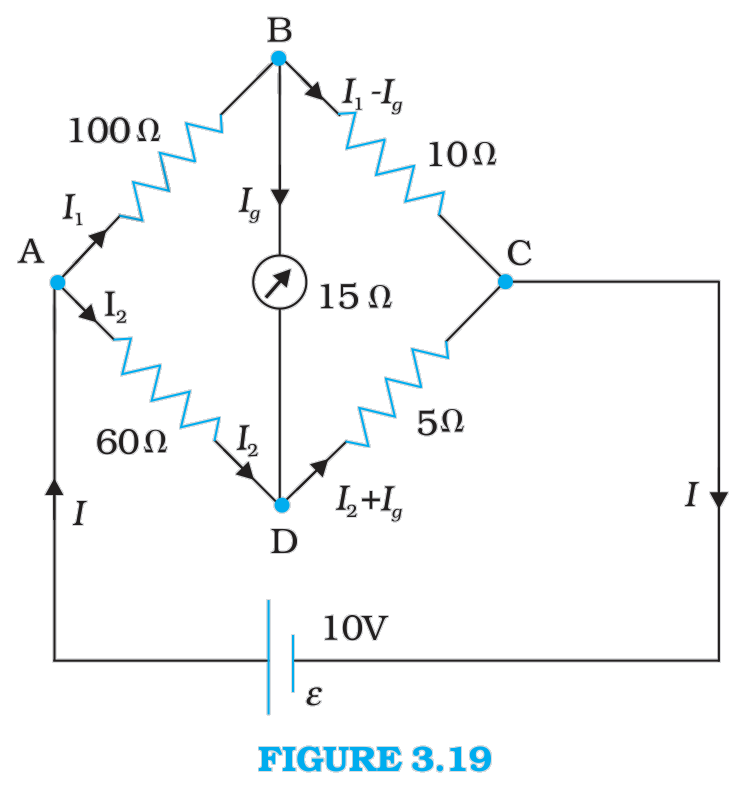
NCERT Fig. 3.19

Advertisement

Practise more on Current Electricity

Chapter-wise mocks on the real NTA exam screen, with solutions and your rank. Your first mocks are free.

Start free mocks →

Advertisement

Next questions

  1. सूची - I को सूची - II से सुमेलित कीजिए :सूची - Iसूची - IIA. मैला आंचलI. प्रेमचंदB. बाणभट्ट की आत्मकथाII. फणीश्वरनाथ रेणुC. शेखर एक जीवनीIII…Hindi · हिंदी साहित्य (रचना, रचनाकार और विधाएँ)
  2. Which of the following are NOT correct explanations? A. Infant mortality rate is the number of deaths of babies before the age of one year…Sociology · Indian Society: Demographic Structure of Indian Society
  3. Demand curve is a ________ presentation of various quantities of a commodity that a consumer is willing to buy at different prices of the s…Economics · Micro Economics: Theory of Consumer behaviour
  4. While judging a personality pageant, raters gave high scores to contestants who were already famous because of their presence in popular T.…Psychology · Self and Personality
  5. The distance of Neptune and Saturn from sun are nearly 1013 and 1012 meters respectively. Assuming that they move in circular orbits, their…Physics · Gravitation
  6. 'Planning requires logical and systematic thinking rather than guess work or wishful thinking.' Identify the related feature of planning.Business Studies · Planning
  7. Based on the data given below, which metal in its +2 oxidation state will not liberate hydrogen from acids? Metal V Ti Co Cr E° (M^3+/M^2+…Chemistry · Inorganic: D and F Block Elements
  8. Which political party did Chaudhary Charan Singh found in 1967?Political Science · Politics in India Since Independence: Crisis of democratic Order
  9. In a class of 35 children, Aarav’s rank is sixth from the top. Ronnie is seven ranks below Aarav. What is Ronnie’s rank from the bottom?General Aptitude Test · Verbal Reasoning
  10. A cell of emf E and internal resistance r gives current of 0.5 A with external resistance of 12 Ω and a current of 0.25 A with an external…Physics · Current Electricity