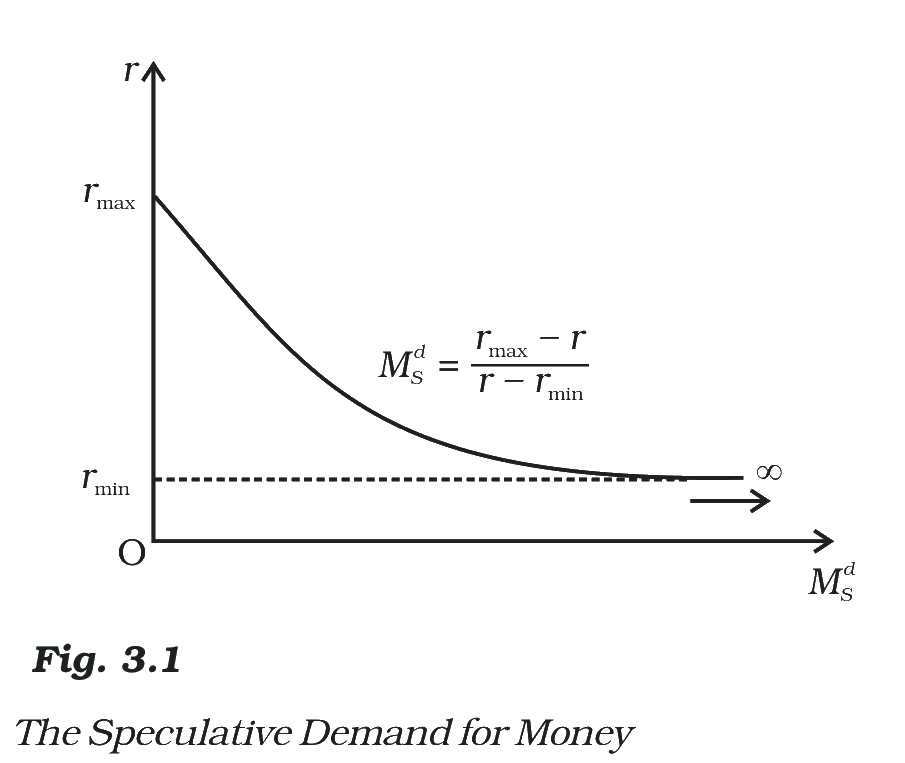
In the figure below, the speculative demand for money is shown against the rate of interest (r). Three labels have been replaced by the numbers 1, 2 and 3.
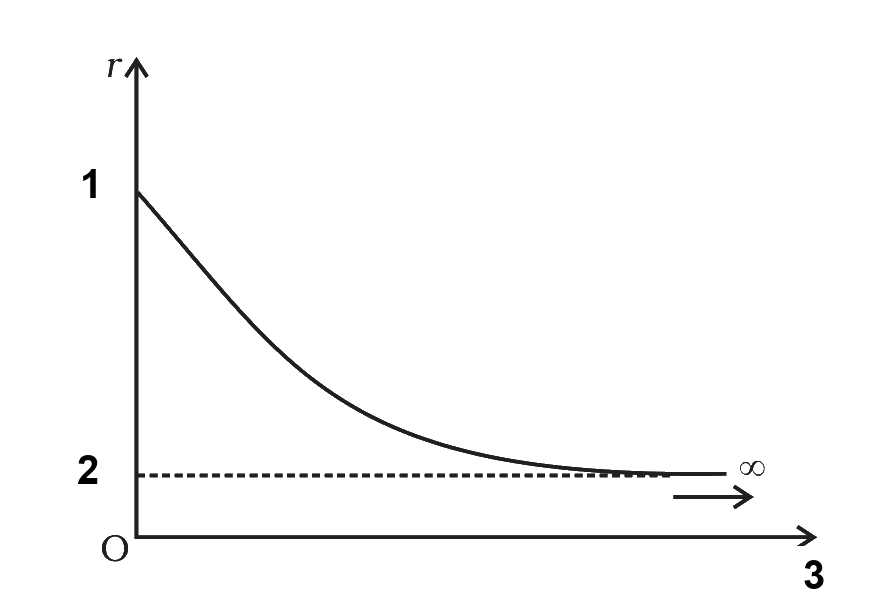
What does the number 2 on the vertical axis mark?
Answer & explanation
Correct answer: option 2
The correct answer is Option (2) → The floor rate of interest, at which the economy is in a liquidity trap
Number 2 is the lowest point on the rate-of-interest axis, rmin. Here the curve turns flat and speculative demand becomes infinite: the economy is in a liquidity trap.
Option (1) The rate of interest at which the speculative demand for money is zero — Incorrect. This is rmax, marked 1.
Option (2) The floor rate of interest, at which the economy is in a liquidity trap — Correct. The rate cannot fall below the floor rmin; extra money is just held as money.
Option (3) The rate of interest at which the transaction demand for money becomes zero — Incorrect. Transaction demand depends on real GDP and the price level, not on this curve.
Option (4) The repo rate at which the RBI lends money to commercial banks — Incorrect. The repo rate is a policy rate of the RBI. The figure shows the market rate.
NCERT (2026-27): “The Speculative Motive … However, if the market rate of interest is already low enough so that everybody expects it to rise in future, causing capital losses, nobody will wish to hold bonds. Everyone in the economy will hold their wealth in money balance and if additional money is injected within the economy it will be used up to satiate people’s craving for money balances without increasing the demand for bonds and without further lowering the rate of interest below the floor rmin. Such a situation is called a liquidity trap. The speculative money demand function is infinitely elastic here. In Fig. 3.1 the speculative demand for money is plotted on the horizontal axis and the rate of interest on the vertical axis. When r = rmax, speculative demand for money is zero. The rate of interest is so high that everyone expects it to fall in future and hence is sure about a future capital gain. Thus everyone has converted the speculative money balance into bonds. When r = rmin, the economy is in the liquidity trap. Everyone is sure of a future rise in interest rate and a fall in bond prices. Everyone puts whatever wealth they acquire in the form of money and the speculative demand for money is infinite. Total demand for money in an economy is, therefore, composed of transaction demand and speculative demand. The former is directly proportional to real GDP and price level, whereas the latter is inversely related to the market rate of interest. …”
|