CUETMOCK
  • Pricing
  • Mentors
Log inStart freeStart free mocks→

First test, then trust

Try a free CUET mock test.

Join 5,00,000+ students who rehearsed exam day on the exact NTA screen before sitting CUET. On the web and on Android.

Start free mocks →Get the Android app
CUETMOCK

India's #1 CUET Mock Test Platform. Original NCERT-based questions on the exact NTA exam screen — trusted by 5,00,000+ students since CUET 2022.

Get it onGoogle PlayScan to download the CUETMOCK app

Mock tests

  • CUET mock test series
  • Browse all papers
  • Commerce mocks
  • Humanities (Arts) mocks
  • Science mocks
  • Languages & GAT mocks
  • Free practice questions
  • Pricing

Resources

  • CUET exam guide
  • CUET syllabus
  • Universities accepting CUET
  • Expert blogs
  • News & notifications
  • Webinars & counselling
  • CUET score calculator
  • How we estimate your rank
  • FAQs

Company

  • About us
  • Our leadership & team
  • Our toppers
  • Mentors
  • For schools
  • Contact us
  • Terms
  • Privacy
  • Refund policy

Talk to us

+91 7696 6630 56info@cuetmock.comWhatsApp us

Our other platforms

  • JEE Mock — For IIT-JEE aspirants
  • NEET Mock — For NEET aspirants

Newsletter

Exam updates, study material and offers — no spam.

© 2026 NYC Ventures Pvt. Ltd.

701-702, Royal Business Park, Zirakpur, Punjab - 140603

  • Terms of use
  • Privacy policy
  • Refund policy
  • Contact us

iCUETMOCK is an independent preparation platform, not affiliated with the National Testing Agency (NTA). Always check exam details on the official NTA website.

  • Home
  • Mock tests
  • CUET guide
  • Pricing
  • Log in
Home/Practice questions/Economics
EconomicsMacro Economics: Introduction

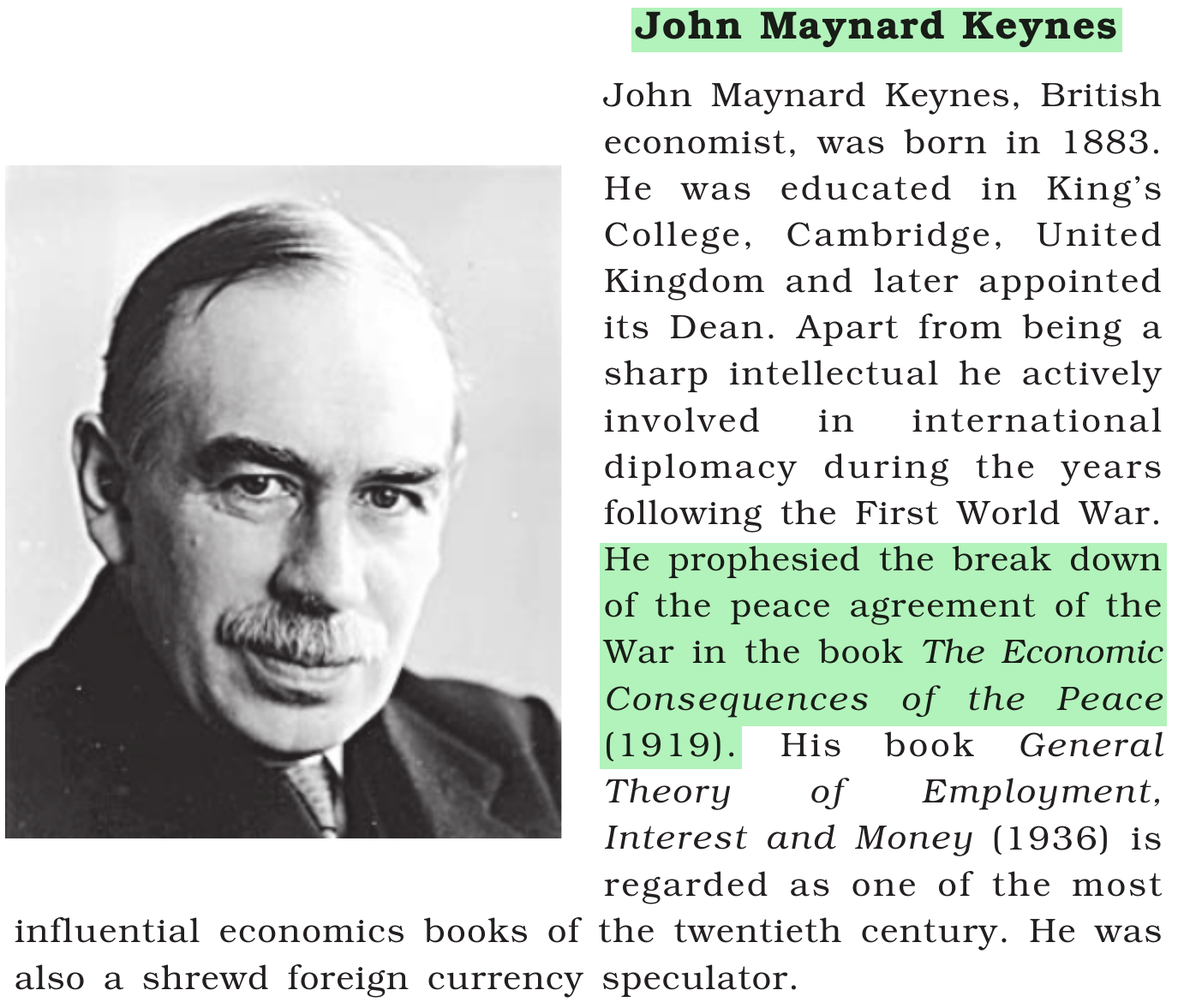
Who wrote the book "The Economic Consequences of the Peace"?

Who wrote the book "The Economic Consequences of the Peace"?

Answer & explanation+

Correct answer: option 1

The correct answer is Option (1) → John Maynard Keynes

John Maynard Keynes, the British economist, wrote The Economic Consequences of the Peace in 1919. In it he foresaw the breakdown of the peace agreement made after the First World War.

Keynes also wrote The General Theory of Employment, Interest and Money (1936), the work with which the subject of macroeconomics was born.


NCERT (2026-27): Introductory Macroeconomics — Chapter 1: Introduction

NCERT extract

Advertisement

Practise more on Macro Economics: Introduction

Chapter-wise mocks on the real NTA exam screen, with solutions and your rank. Your first mocks are free.

Start free mocks →

Advertisement

Next questions

  1. The process of controlling involves the following steps: (A) Measurement of actual performance (B) Setting performance standards (C) Analys…Business Studies · Controlling
  2. Gabriel phthalimide synthesis is used for the preparation of:Chemistry · Organic: Amines
  3. A dishonest dealer claims to sell a product at its cost price. He uses a counterfeit weight that is 20% less than the real weight and also…General Aptitude Test · Numerical Ability
  4. Find all pairs of consecutive odd positive integers, both of which are larger than 10 such that their sum is less than 40.Applied Maths. Section B2 · Numbers, Quantification and Numerical Applications
  5. Evaluate: ∫limits_1^3 (x - 1)(x - 2)(x - 3) dxMaths. Section B1 · Definite Integration
  6. If y = y(x) is the solution of the differential equation displaystyledy/dx = 3x^2 + 4x satisfying y(1) = 5 , then y(2) is equal toMaths. Section A · Differential Equations (Section A)
  7. Arrange the following sentences in a logical order to form a coherent paragraph:(A) In the wettest parts of Meghalaya, ordinary wooden brid…English · Arrange in Meaningful Sequence
  8. From the given list, choose the one word substitute for 'one who does not believe in God'English · One Word
  9. Find the odd one out in the given sequence.1296, 648, 216, 108, 34, 18General Aptitude Test · Verbal Reasoning
  10. Who was the Prime Minister during the NDA governments formed in 1998 and 1999?Political Science · Politics in India Since Independence: Recent Developments in Indian Politics