
Read the passage and answer the following questions:
In almost all recombinant technologies, the ultimate aim is to produce a desirable protein. Hence, there is a need for the recombinant DNA to be expressed. The foreign gene gets expressed under appropriate conditions. After having cloned the gene of interest and having optimised the conditions to induce the expression of the target protein, one has to consider producing it on a large scale. The cells harbouring cloned genes of interest may be grown on a small scale in the laboratory. The cultures may be used for extracting the desired protein and then purifying it by using different separation techniques. Small volume cultures cannot yield appreciable quantities of products. To produce in large quantities, the development of bioreactors, where large volumes of culture can be processed, was required. The most commonly used bioreactors are of stirring type.
In a sparged stirred-tank bioreactor, sterile air bubbles are sparged through the culture. Bubbling air through the reactor is an alternative way of meeting which need that the stirrer also meets?
Answer & explanation
Correct answer: option 1
The correct answer is Option (1) → Oxygen availability throughout the bioreactor
The stirrer in a bioreactor does two things: it mixes the culture evenly and it makes oxygen available everywhere in the vessel. Bubbling sterile air through the culture is the other way of getting oxygen to the cells. In a sparged reactor the many small bubbles greatly increase the area for oxygen transfer (Figure 9.7b).
Option (1) Oxygen availability throughout the bioreactor — Correct. Air bubbled through the reactor carries oxygen to all parts of the culture, the same need the stirrer meets.
Option (2) Maintaining the optimum pH of the culture — Incorrect. pH is held by the pH control system, which adds acid or base. Air bubbles are not used for this.
Option (3) Control of the foam formed in the culture — Incorrect. Foam is dealt with by the foam control system. Bubbling air into the culture does not remove foam.
Option (4) Sterilisation of the medium before the cells are added — Incorrect. The air sparged in is itself sterile, but it does not sterilise the medium. Figure 9.7a shows steam being used for sterilisation.
Note: The word ‘sparged’ is not in the running text at all. It sits only in the caption of Figure 9.7, with the labels ‘Steam for sterilisation’ and ‘Acid/Base for pH control’ on the drawing beside it. A two-panel figure can quietly hold three options of one question.
NCERT Extract:
Obtaining the Foreign Gene Product – “… The stirrer facilitates even mixing and oxygen availability throughout the bioreactor. Alternatively air can be bubbled through the reactor. If you look at the figure closely you will see that the bioreactor has an agitator system, an oxygen delivery system and a foam control system, a temperature control system, pH control system and sampling ports so that small volumes of the culture can be withdrawn periodically.”
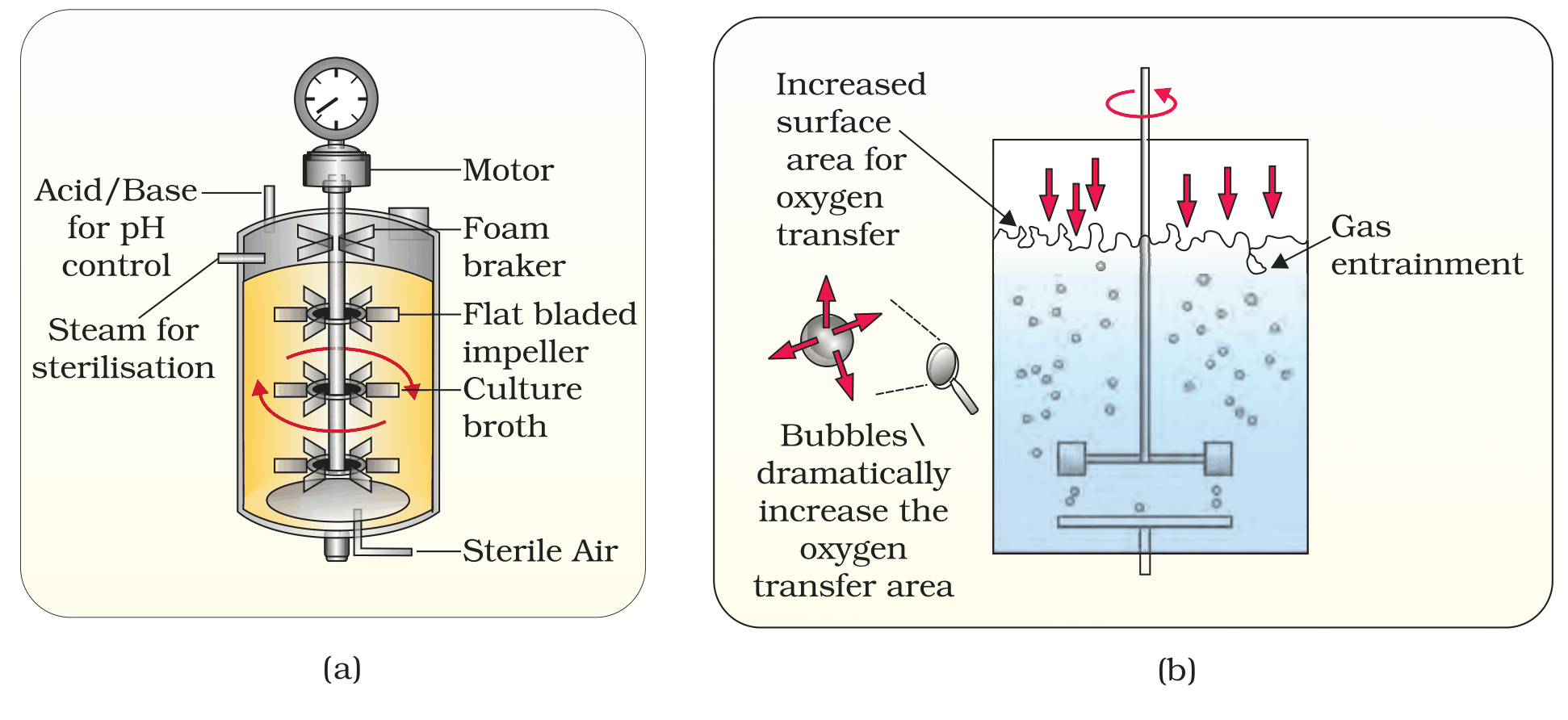
Figure 9.7 (a) Simple stirred-tank bioreactor; (b) Sparged stirred-tank bioreactor through which sterile air bubbles are sparged