Match List I with List II
| LIST-I (Contribution) | LIST-II (Important Personalities) | ||
| A. | Brahmo Samaj | I. | M. G. Ranade |
| B. | Widow remarriage | II. | Raja Ram Mohan Roy |
| C. | Country's first school for girls | III. | Jyotiba Phule |
| D. | Anti Caste Movement | IV. | Savitri Bai Phule |
Choose the correct answer from the options given below:
Answer & explanation
Correct answer: option 3
The correct answer is Option (3) → A-II, B-I, C-IV, D-III
(A) Brahmo Samaj — this matches (II) Raja Ram Mohan Roy.
(B) Widow remarriage — this matches (I) M. G. Ranade.
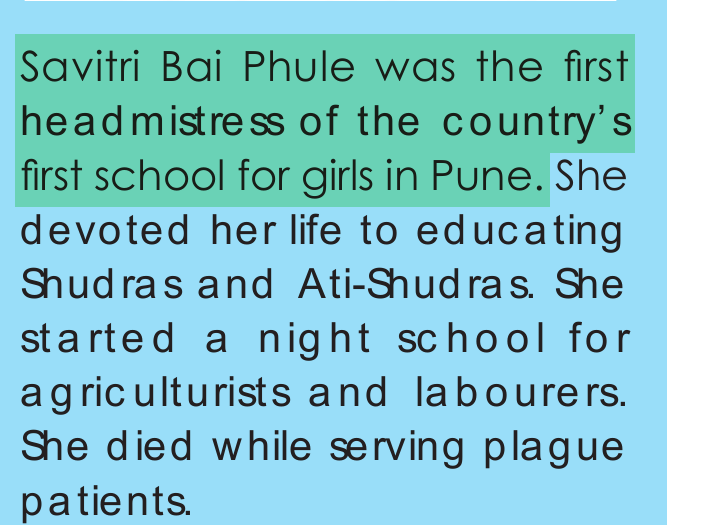
(C) Country’s first school for girls — this matches (IV) Savitri Bai Phule.
(D) Anti Caste Movement — this matches (III) Jyotiba Phule.
NCERT (2025-26): “5.3 Struggle for women’s equality and rights … Many used both these resources to fight for women’s rights. We can only give illustrative examples here. We draw from the anti-sati campaign led by Raja Rammohun Roy in Bengal, the widow remarriage movement in the Bombay Presidency where Ranade was one of the leading reformers, from Jyotiba Phule’s simultaneous attack on caste and gender oppression, and from the social reform movement in Islam led by Sir Syed Ahmed Khan. Raja Rammohun Roy’s attempts to reform society, religion and the status of women can be taken as the starting point of nineteenth century social reform in Bengal. A decade before establishing the Brahmo Samaj in 1828, Roy undertook the campaign against ‘sati’ which was the first women’s issue to receive public attention.…” “While Ranade and Rammohun Roy belonged to one kind of nineteenth century upper caste and middle class social reformers, Jotiba Phule came from a socially excluded caste and his attack was directed against both caste and gender discrimination. He founded the Satyashodak Samaj with its primary emphasis on ‘truth seeking’. Phule’s first practical social reform efforts were to aid the two groups considered lowest in traditional Brahmin culture: women and untouchables.…”
Savitri Bai Phule, margin box in the chapter ‘Social Institutions: Continuity and Change’ (NCERT 2025-26) |