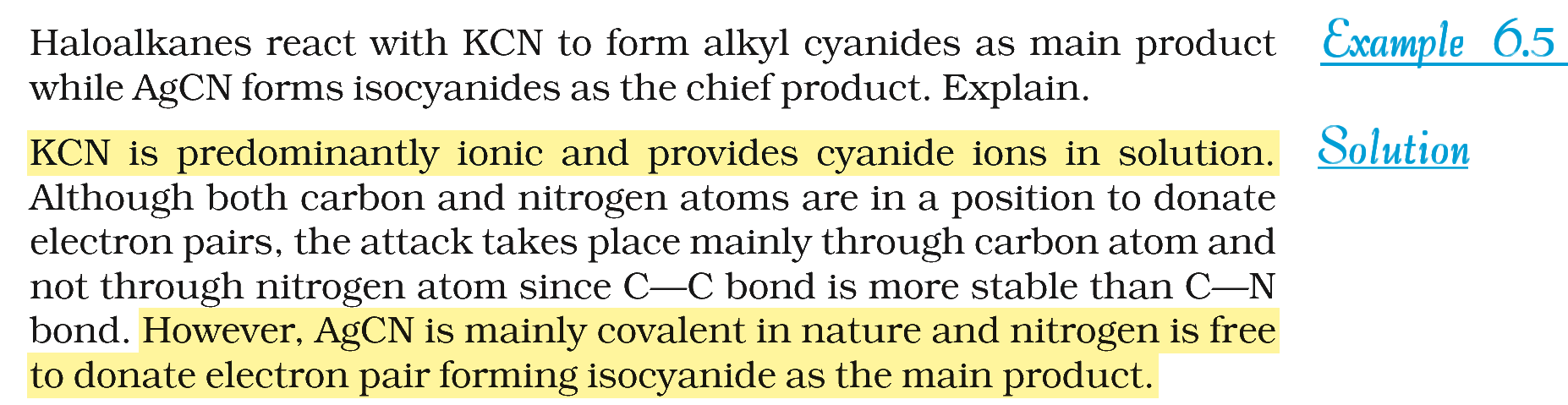
AgCN forms isocyanide with haloalkane because
A. AgCN is ionic in nature.
B. AgCN is covalent in nature.
C. Nitrogen is free to donate electron pair
D. Carbon is negatively charged.
Choose the correct answer from the options given below:
Answer & explanation
Correct answer: option 3
The correct answer is Option (3) → B and C only
The cyanide group is an ambident nucleophile: it can attack through carbon or through nitrogen, because both atoms carry a lone pair:
\( \displaystyle [:\ce{C#N}:]^- \)
\( \displaystyle \ce{R-X + KCN -> R-CN + KX} \)
\( \displaystyle \ce{R-X + AgCN -> R-NC + AgX} \)
A. AgCN is ionic in nature. — Incorrect. AgCN is largely covalent; an ionic cyanide such as KCN gives the nitrile, not the isocyanide.
B. AgCN is covalent in nature. — Correct. Because of the covalent Ag–C bond, the carbon end is not available for attack.
C. Nitrogen is free to donate electron pair — Correct. The lone pair on nitrogen attacks the carbon of the haloalkane and forms the C–N bond of the isocyanide.
D. Carbon is negatively charged. — Incorrect. In AgCN the carbon is bonded to silver and is not a free anionic centre; if carbon attacked, a nitrile would form.
NCERT (2026-27 edition):
Reactions of Haloalkanes – …