
Reproduction in humans
Read the following passage carefully and answer the given questions.
The female reproductive system consists of a pair of ovaries, a pair of oviducts, a uterus, a vagina, external genitalia, and a pair of mammary glands. The ovaries produce the female gamete and some steroidal hormones. Ovarian follicles in different stages of development are embedded in the stroma. The oviducts, uterus and vagina are female accessory ducts. The uterus has three layers, namely perimetrium, myometrium and endometrium. The female external genitalia includes mons pubis, labia majora, labia minora, hymen and clitoris. The mammary glands are one of the female secondary sexual characteristics. Spermatogenesis results in the formation of sperm that is transported by the male sex accessory ducts. A normal human sperm is composed of a head, neck, a middle piece and tail. The process of formation of mature female gametes is called oogenesis. The reproductive cycle of female primates is called the menstrual cycle. The menstrual cycle starts only after attaining sexual maturation. During ovulation, only one ovum is released per menstrual cycle. The cyclical changes in the ovary and the uterus during the menstrual cycle are induced by changes in the levels of pituitary and ovarian hormones.
The sperm head is covered by a structure called:
Answer & explanation
Correct answer: option 4
The correct answer is Option (4) → Acrosome
A human sperm has a head, a neck, a middle piece and a tail. The head holds the haploid nucleus, and the front part of the head is covered by a cap-like structure.
(1) Antrum — Incorrect. This is the fluid-filled cavity of the follicle in the ovary. It has nothing to do with the sperm.
(2) Spermatid — Incorrect. This is a cell of spermatogenesis. By spermiogenesis it is changed into a sperm. It is not a covering of the head.
(3) Seminal vesicle — Incorrect. This is a male accessory gland. Its secretion is a part of the seminal plasma. It is not a part of the sperm.
(4) Acrosome — Correct. It is the cap on the front of the sperm head. It is filled with enzymes that help the sperm to enter the ovum during fertilisation.
Note: The passage is taken from NCERT. NTA has put lines of the NCERT text together to make it. Most CUET (UG) questions come straight from NCERT, so study the book line by line, including figures and their titles.
NCERT Extract:
Gametogenesis – …
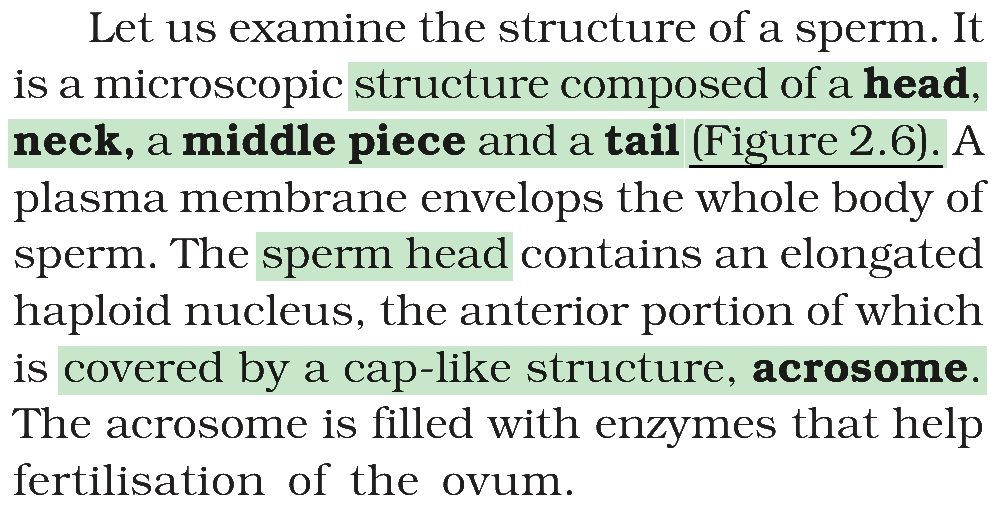
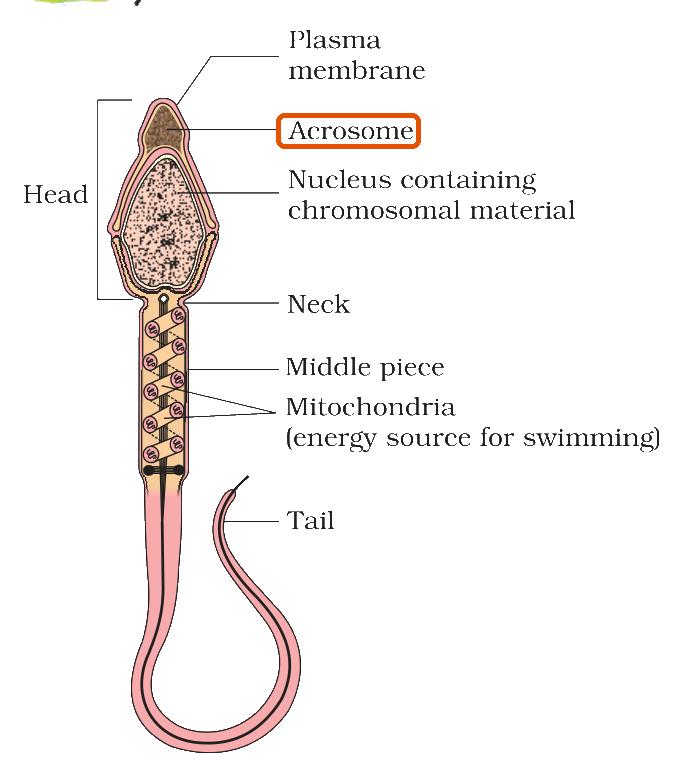
Figure 2.6 Structure of a sperm