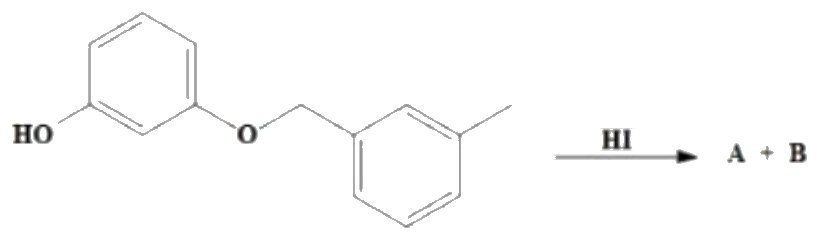
In the following reaction, the major products A and B respectively, are
Answer & explanation
Correct answer: option 2
The correct answer is Option (2) → A = Resorcinol, B = 1-Iodomethyl-3-methylbenzene
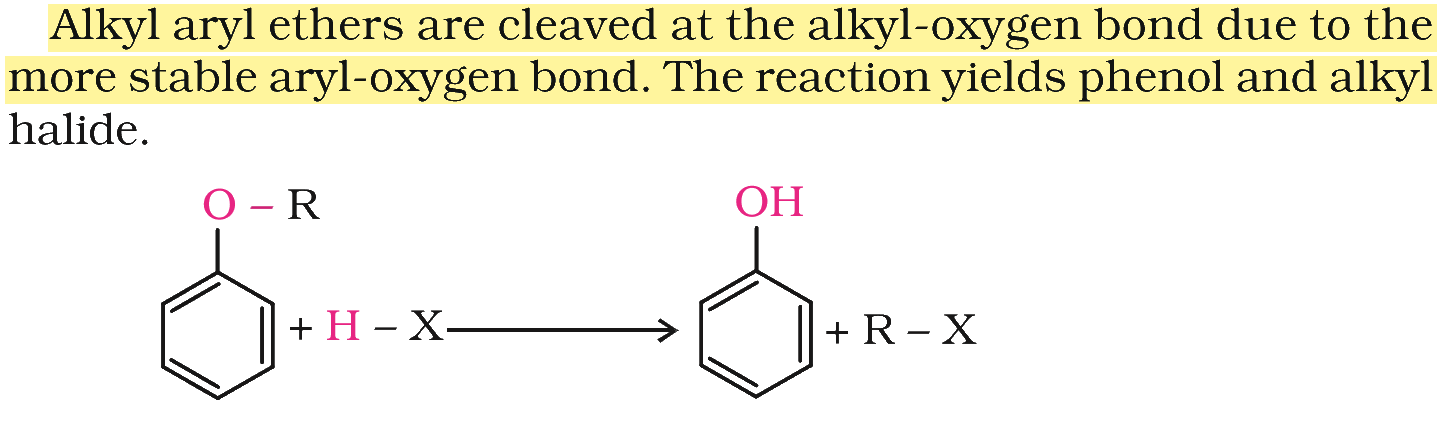
Ethers are cleaved by HI. The ether oxygen is first protonated, and then the iodide ion attacks one of the two carbon atoms bonded to oxygen. Which C–O bond breaks depends on the groups:
Aryl–O bond: it has partial double bond character (the oxygen lone pair is in resonance with the ring), so it is not broken. The aryl side always ends up as a phenol.
Alkyl or benzyl–O bond: this carbon is attacked by \( \ce{I^{-}} \), so this side ends up as an alkyl (or benzyl) iodide. A benzylic carbon reacts readily because its carbocation / transition state is stabilised by the ring.
\( \displaystyle \ce{Ar-O-CH2-Ar' + HI -> Ar-OH + I-CH2-Ar'} \)
In the given ether the oxygen joins a 3-hydroxyphenyl ring to a 3-methylbenzyl group (–\( \ce{CH2} \)– on a ring that carries \( \ce{CH3} \) in the meta position):
The aryl side takes an H and becomes 1,3-dihydroxybenzene, i.e. resorcinol (A).
The benzyl side takes the iodine and becomes 3-\( \ce{CH3C6H4CH2I} \), i.e. 1-iodomethyl-3-methylbenzene (B).
For the given ether:
\( \displaystyle \ce{HO-C6H4-O-CH2-C6H4-CH3 + HI} \xrightarrow{\text{heat}} \underset{\text{resorcinol}}{\ce{HO-C6H4-OH}} + \underset{\text{1-iodomethyl-3-methylbenzene}}{\ce{I-CH2-C6H4-CH3}} \)
Why the other options are incorrect
Option (1) A = Resorcinol, B = 2-Methylbenzyl alcohol — Incorrect. With excess HI the benzyl side gives an iodide, not an alcohol, and the methyl group is at position 3, not 2.
Option (3) A = 3-Methylbenzyl alcohol, B = m-cresol — Incorrect. This would need the Ar–O bond of the hydroxyphenyl ring to break and the ring to lose its oxygen, which does not happen; m-cresol is not even part of the molecule.
Option (4) A = 3-Methylbenzyl alcohol, B = Catechol — Incorrect. Catechol is 1,2-dihydroxybenzene; the two oxygens in the ether ring are in the 1,3 (meta) positions, which gives resorcinol.
NCERT (2026-27 edition):
Chemical Reactions – …