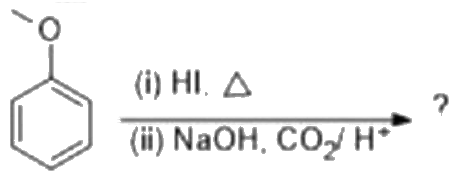
The final aromatic product of the following reaction is
Answer & explanation
Correct answer: option 4
The correct answer is Option (4) → Salicylic acid
The reaction takes place in two stages.
(i) Cleavage of an alkyl aryl ether by HI. The O–aryl bond is strong because it has partial double bond character (the lone pair on oxygen is in resonance with the ring). So the bond that breaks is \( \ce{O-CH3} \): the ether oxygen is protonated and \( \ce{I^{-}} \) attacks the methyl carbon. The products are phenol and methyl iodide.
\( \displaystyle \ce{C6H5OCH3 + HI -> C6H5OH + CH3I} \)
(ii) Kolbe’s reaction. NaOH converts phenol into sodium phenoxide. The phenoxide ion is even more reactive than phenol towards electrophiles, so it reacts with the weak electrophile \( \ce{CO2} \) at the ortho position. Acidification then gives 2-hydroxybenzoic acid (salicylic acid).
\( \displaystyle \ce{C6H5OH} \xrightarrow{\ce{NaOH}} \ce{C6H5ONa} \xrightarrow[\text{(ii) }\ce{H^+}]{\text{(i) }\ce{CO2}} \ce{HOC6H4COOH} \)
So the final aromatic product is salicylic acid.
Why the other options are incorrect
Option (1) Salicylaldehyde — Incorrect. It forms in the Reimer–Tiemann reaction, when phenol is treated with \( \ce{CHCl3} \) and NaOH, not with \( \ce{CO2} \).
Option (2) Benzaldehyde — Incorrect. No step removes the –OH group or introduces a –CHO group.
Option (3) Phenol — Incorrect. Phenol is formed in step (i), but step (ii) converts it further.
NCERT (2026-27 edition):
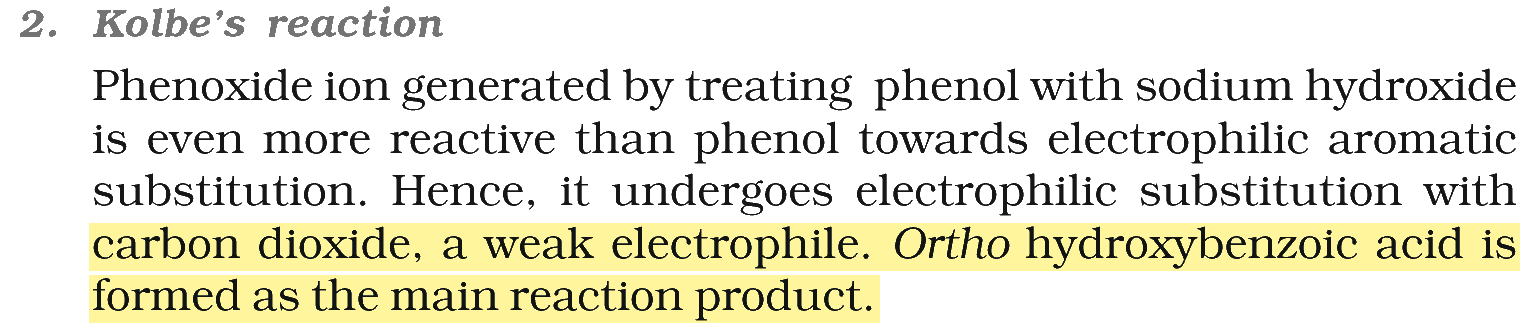
Kolbe’s Reaction