
Read the given passage and answer the following questions:
Managing diabetes is possible by administering insulin periodically. Insulin used for diabetes was earlier extracted from pancreas of slaughtered cattle and pigs. However, this insulin caused some people to develop allergies and other types of reactions. In mammals, including humans, insulin is synthesised as a prohormone and is later converted to insulin. Insulin consists of two short polypeptide chains: chain A and chain B, that are linked together by disulphide bridges.
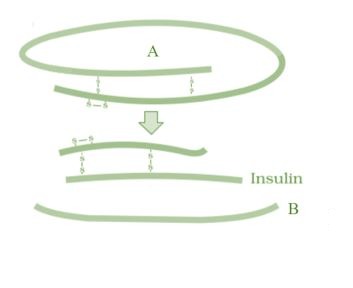
Identify A and B in the picture.
Answer & explanation
Correct answer: option 2
The correct answer is Option (2) → A: Proinsulin; B: Free C peptide
The figure shows the maturation of insulin. The large loop at the top (A) is pro-insulin, the form in which insulin is first made. It carries an extra stretch, the C peptide. During maturation the C peptide is cut away, leaving insulin made of chain A and chain B joined by disulphide bridges. The separate strand at the bottom (B) is the free C peptide.
Option (1) A: Proinsulin; B: A peptide — Incorrect. A is pro-insulin, but B is not chain A. Chain A is part of the insulin labelled in the middle of the figure.
Option (2) A: Proinsulin; B: Free C peptide — Correct. A is the pro-insulin with its extra stretch, and B is the free C peptide released when pro-insulin matures into insulin.
Option (3) A: A peptide; B: Free C peptide — Incorrect. A is the whole pro-insulin molecule, not a single chain. Chain A is only one part of the insulin formed from it.
Option (4) A: A peptide; B: B peptide — Incorrect. Chains A and B together make the insulin shown in the middle of the figure. Neither the top loop nor the free strand below it is one of these chains.
Note: Pro-insulin, the free C peptide and the two chains are all named in Figure 10.3, and here two of those names are hidden behind letters. If you can sketch the book’s figures with their labels, a covered label will not slow you down.
NCERT Extract:
Genetically Engineered Insulin – “… In mammals, including humans, insulin is synthesised as a pro-hormone (like a pro-enzyme, the pro-hormone also needs to be processed before it becomes a fully mature and functional hormone) which contains an extra stretch called the C peptide. This C peptide is not present in the mature insulin and is removed during maturation into insulin.”
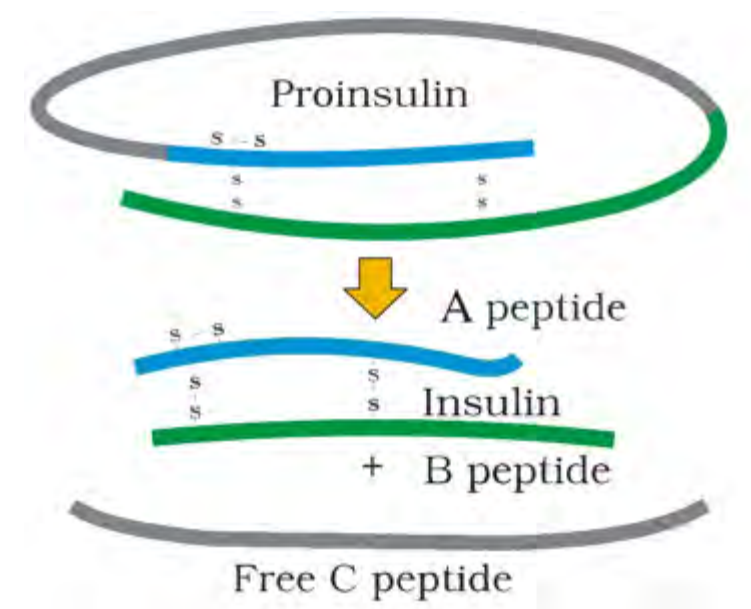
Figure 10.3 Maturation of pro-insulin into insulin (simplified)