
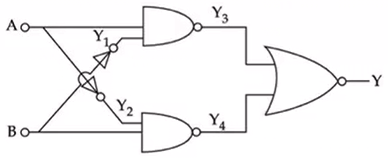
Which of the following truth tables is true for the following circuit?
Answer & explanation
Correct answer: option 1
The correct answer is Option (1)
The circuit is two NOT gates (the input lines cross, so \( Y_1 \) is the inverse of B and \( Y_2 \) the inverse of A), two NAND gates and a final NOR gate:
\( Y_1 = \overline{B},\quad Y_2 = \overline{A} \)
\( Y_3 = \overline{A\cdot Y_1},\quad Y_4 = \overline{Y_2\cdot B} \)
\( Y = \overline{Y_3 + Y_4} \)
Taking each input pair in turn (A, B):
(0, 0): \( Y_1 = 1,\ Y_2 = 1,\ Y_3 = 1,\ Y_4 = 1,\ Y = 0 \)
(1, 0): \( Y_1 = 1,\ Y_2 = 0,\ Y_3 = 0,\ Y_4 = 1,\ Y = 0 \)
(0, 1): \( Y_1 = 0,\ Y_2 = 1,\ Y_3 = 1,\ Y_4 = 0,\ Y = 0 \)
(1, 1): \( Y_1 = 0,\ Y_2 = 0,\ Y_3 = 1,\ Y_4 = 1,\ Y = 0 \)
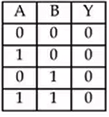
The output is 0 for every input, which is the truth table of Option (1).
Shortcut: Since \( Y = \overline{Y_3}\cdot\overline{Y_4} \), we get \( Y = (A\cdot\overline{B})(\overline{A}\cdot B) \). This product contains both A and \( \overline{A} \), so it is always 0, and the all-zero table follows without any rows.