Arrange the following events in the correct sequence of occurrence.
(A) Under Article 352 of the Constitution, the government declared that there was a threat of internal disturbances.
(B) The constitution bench of the Supreme Court decided during Emergency the government could take away the citizen's right to life and liberty.
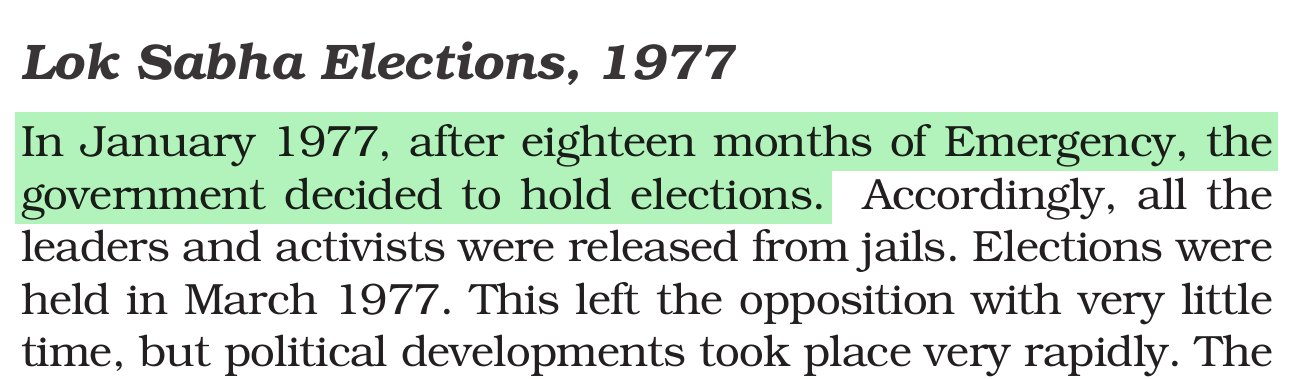
(C) After eighteen months of Emergency, the government decided to hold elections.
(D) The Supreme Court decided the Keshavananda Bharati case
Choose the correct answer from the options given below:
Answer & explanation
Correct answer: option 3
The correct answer is Option (3) → (D), (A), (B), (C)
(D) The Supreme Court decided the Keshavananda Bharati case — 1973.
(A) Under Article 352 of the Constitution, the government declared that there was a threat of internal disturbances. — 25 June 1975.
(B) The constitution bench of the Supreme Court decided during Emergency the government could take away the citizen’s right to life and liberty. — April 1976.
(C) After eighteen months of Emergency, the government decided to hold elections. — January 1977.
NCERT (2026-27): “Conflict with Judiciary … Two developments further added to the tension between the judiciary and the executive. Immediately after the Supreme Court’s decision in 1973 in the Keshavananda Bharati case, a vacancy arose for the post of the Chief Justice of India.… Crisis and response … The response of the government was to declare a state of emergency. On 25 June 1975, the government declared that there was a threat of internal disturbances and therefore, it invoked Article 352 of the Constitution. Under the provision of this article the government could declare a state of emergency on grounds of external threat or a threat of internal disturbances.… Consequences … In April 1976, the constitution bench of the Supreme Court over-ruled the High Courts and accepted the government’s plea. It meant that during Emergency the government could take away the citizen’s right to life and liberty. This judgment closed the doors of judiciary for the citizens and is regarded as one of the most controversial judgments of the Supreme Court.”
|