Match the List-I with List-II
| List-I | List-II |
| Character | Recessive Trait |
| (A) Flower Colour | (I) Green |
| (B) Seed colour | (II) Yellow |
| (C) Pod colour | (III) Constricted |
| (D) Pod shape | (IV) White |
Choose the correct answer from the options given below:
Answer & explanation
Correct answer: option 4
The correct answer is Option (4) - (A)-(IV), (B)-(I), (C)-(II), (D)-(III)
| List-I | List-II |
| Character | Recessive Trait |
| (A) Flower Colour | (IV) White |
| (B) Seed colour | (I) Green |
| (C) Pod colour | (II) Yellow |
| (D) Pod shape | (III) Constricted |
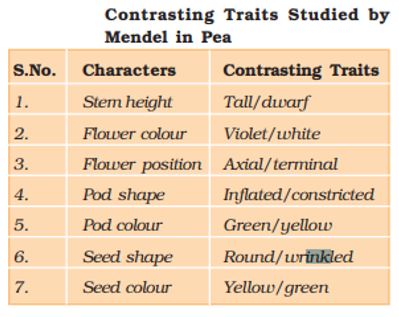
Gregor Mendel, often called the father of genetics, conducted pioneering experiments on pea plants (Pisum sativum) to understand how traits are inherited. He selected pea plants for several reasons, one being that they have clear, observable traits that make inheritance patterns easier to track. For example, traits like flower color, seed shape, and plant height were easy to distinguish between individuals.
Contrasting characters refer to pairs of opposing traits for a single characteristic. For instance, for the seed shape trait, peas can either be round or wrinkled—these are the two contrasting characters. Mendel worked with seven such pairs of contrasting traits, such as: