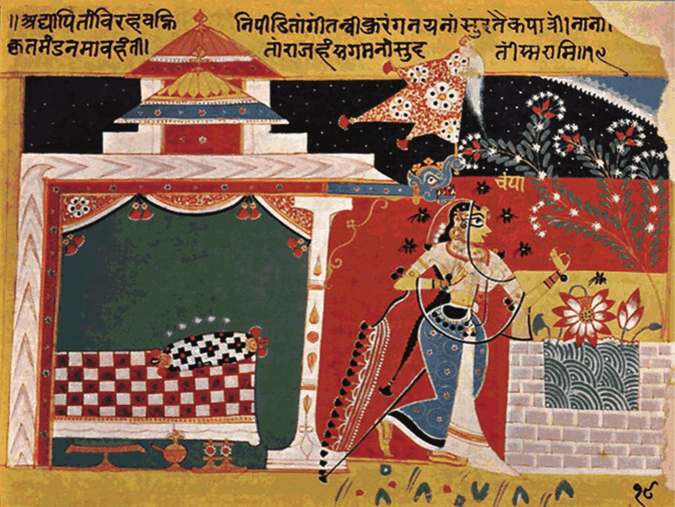
Which of the following painted manuscripts are considered under Western Indian School of Painting?
A. Astasahasrika Prajnaparamita
B. Nimatnama
C. Chaurpanchashika
D. Sangrahini Sutra
Choose the correct answer from the options given below:
Answer & explanation
Correct answer: option 4
The correct answer is Option (4) → B, C and D only
The Western Indian School is the painting of western India: Gujarat above all, with southern Rajasthan and western Central India.
A. Astasahasrika Prajnaparamita Incorrect. It is a Buddhist palm-leaf manuscript of the Pala School of eastern India.
B. Nimatnama Correct. This book of recipes was painted at Mandu under Nasir Shah Khalji. It is the most representative example of the Sultanate style, which grew in the courts of the Sultans of Malwa, Gujarat and other centres when Persian features mixed with the indigenous style.
C. Chaurpanchashika Correct. It is a work of the indigenous, pre-Mughal style that grew beside Jain painting among feudal lords and rich patrons.
D. Sangrahini Sutra Correct. It is a Jain cosmological text, painted in many copies for the Jain community.
NCERT (2026-27): “Western Indian School of Painting …Other popularly painted texts are Kalakacharyakatha and Sangrahini Sutra, among others.…” “Western Indian School of Painting …A large group of works of the same period, portraying Hindu and Jain subjects, such as the Mahapurana, Chaurpanchashika, Aranyaka Parvan of the Mahabharata, Bhagvata Purana, Gita Govinda, and few others are representative of this indigenous style of painting.…” “Western Indian School of Painting …Nimatnama (Book of Delicacies) the most representative example of this school was painted at Mandu during the reign of Nasir Shah Khalji (1500–1510 CE).…” “Pala School of Painting …A fine example of a Pala Buddhist palm leaf manuscript is Astasahasrika Prajnaparamita (Bodleian Library, Oxford) or the ‘Perfection of Wisdom’ written in eight thousand lines.…”
Chaurpanchasika, Gujarat, fifteenth century, N. C. Mehta Collection, Ahmedabad, Gujarat |