Read the following passage and answer the questions.
The oxygen nucleus \({}^{16}_{8}\mathrm{O}\) contains 8 protons and 8 neutrons. A student adds up the masses of 8 free protons and 8 free neutrons. She then compares this total with the mass of the oxygen nucleus. The mass of the oxygen atom is measured very precisely with a mass spectrometer, and the mass of the nucleus is found from it. The nucleus turns out to be lighter than its separate nucleons put together. This difference in mass is called the mass defect. The nucleons stay together in the nucleus because of the nuclear force. The student also looks at a graph of the binding energy per nucleon against the mass number A for a large number of nuclei. The curve is smooth and changes slowly. At nuclides such as \({}^{4}\mathrm{He}\) and \({}^{16}\mathrm{O}\), it shows small peaks.
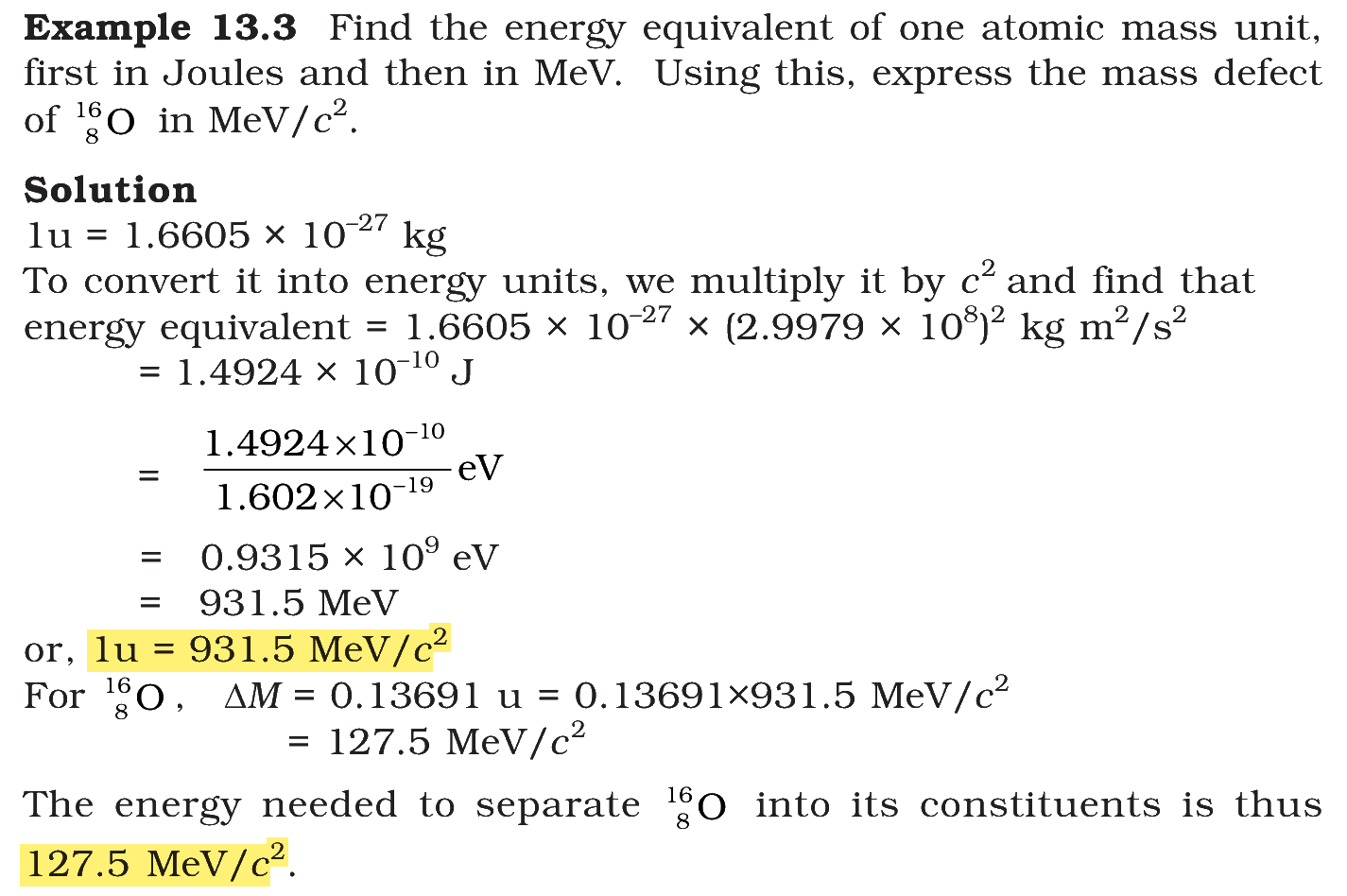
The mass defect of \( {}^{16}_{8}\mathrm{O} \) is \( \Delta M=0.13691\,\mathrm{u} \). Expressed in \( \mathrm{MeV}/c^{2} \) \( \left(1\,\mathrm{u}=931.5\,\mathrm{MeV}/c^{2}\right) \), it is
Answer & explanation
Correct answer: option 1
The correct answer is Option (1) → \( 127.5\,\mathrm{MeV}/c^{2} \)
By Einstein’s mass-energy equivalence \( E=mc^{2} \), a mass can be written as an energy divided by \( c^{2} \). Using \( 1\,\mathrm{u}=931.5\,\mathrm{MeV}/c^{2} \), the mass defect of oxygen-16 is:
\( \begin{aligned} \Delta M &= 0.13691\,\mathrm{u} \\ &= 0.13691\times931.5\,\mathrm{MeV}/c^{2} \\ &= 127.5\,\mathrm{MeV}/c^{2} \end{aligned} \)
Therefore, the energy needed to separate \( {}^{16}_{8}\mathrm{O} \) into its 8 protons and 8 neutrons is about 127.5 MeV.
NCERT (2026-27):
Example 13.3