What is the coordination number of \( Fe \) in \( [Fe(CO)_5] \) and \( [Fe(C_2O_4)_3]^{3-} \) respectively?
Answer & explanation
Correct answer: option 4
The correct answer is Option (4) → 5 and 6
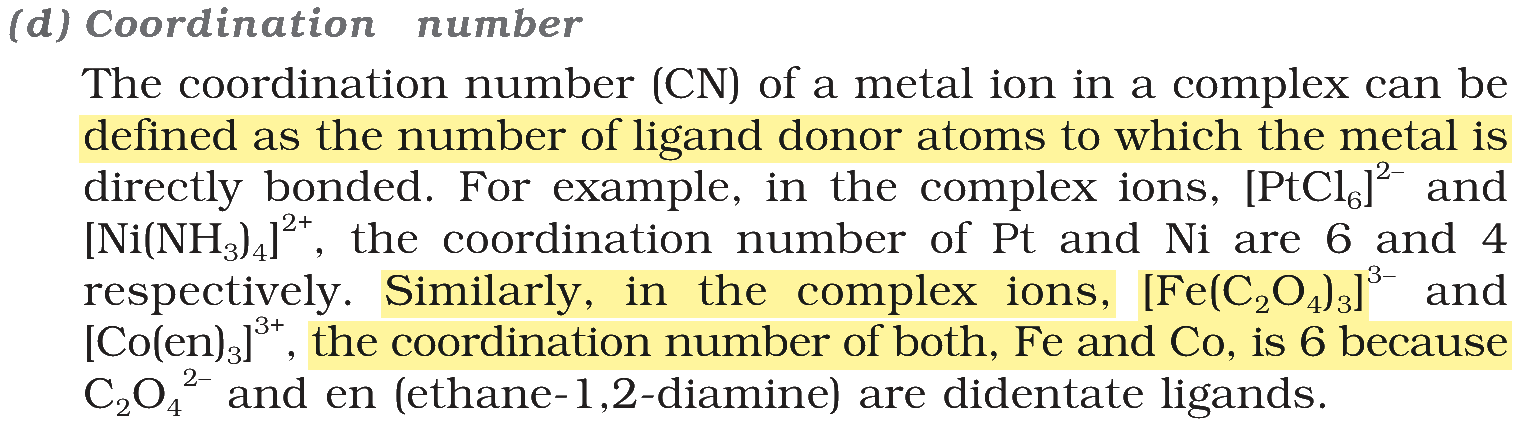
The coordination number of a metal in a complex is the number of ligand donor atoms directly bonded to it, not the number of ligands. A monodentate ligand gives one donor atom; a didentate ligand gives two.
\( \ce{[Fe(CO)5]} \): each CO binds through its carbon atom only (monodentate). Five CO ligands give 5 × 1 = 5 donor atoms.
\( \ce{[Fe(C2O4)3]^3-} \): the oxalate ion, \( \ce{C2O4^2-} \), binds through two oxygen atoms (didentate). Three oxalate ligands give 3 × 2 = 6 donor atoms, arranged octahedrally.
So the coordination numbers are 5 and 6, respectively.
Why the other options are incorrect
Option (1) 3 and 5 — Incorrect. The first value would count the three oxalate ligands of the second complex instead of donor atoms, and the order of the two complexes is reversed.
Option (2) 6 and 5 — Incorrect. These are the right numbers in the wrong order; the carbonyl complex has 5 and the oxalato complex 6.
Option (3) 5 and 3 — Incorrect. The 3 counts the oxalate ligands, but each oxalate is didentate, so the three ligands supply six donor atoms.
NCERT (2026-27 edition):
Coordination Number