Match List-I with List-II
|
List-I |
List-II |
|
(A) Restricts the right to transfer its shares |
(I) OPC |
|
(B) A company which is a subsidiary of a public company |
(II) Private Company |
|
(C) A company which has only one person as a member |
(III) Perpetual Succession |
|
(D) Members may come and go but the company continues |
(IV) Public Company |
Choose the correct answer from the options given below:
Answer & explanation
Correct answer: option 1
The correct answer is Option (1) → (A)-(II), (B)-(IV), (C)-(I), (D)-(III)
Companies are grouped by the number of members (public, private, one person company), and every company has the features of a body corporate, one of which is perpetual succession.
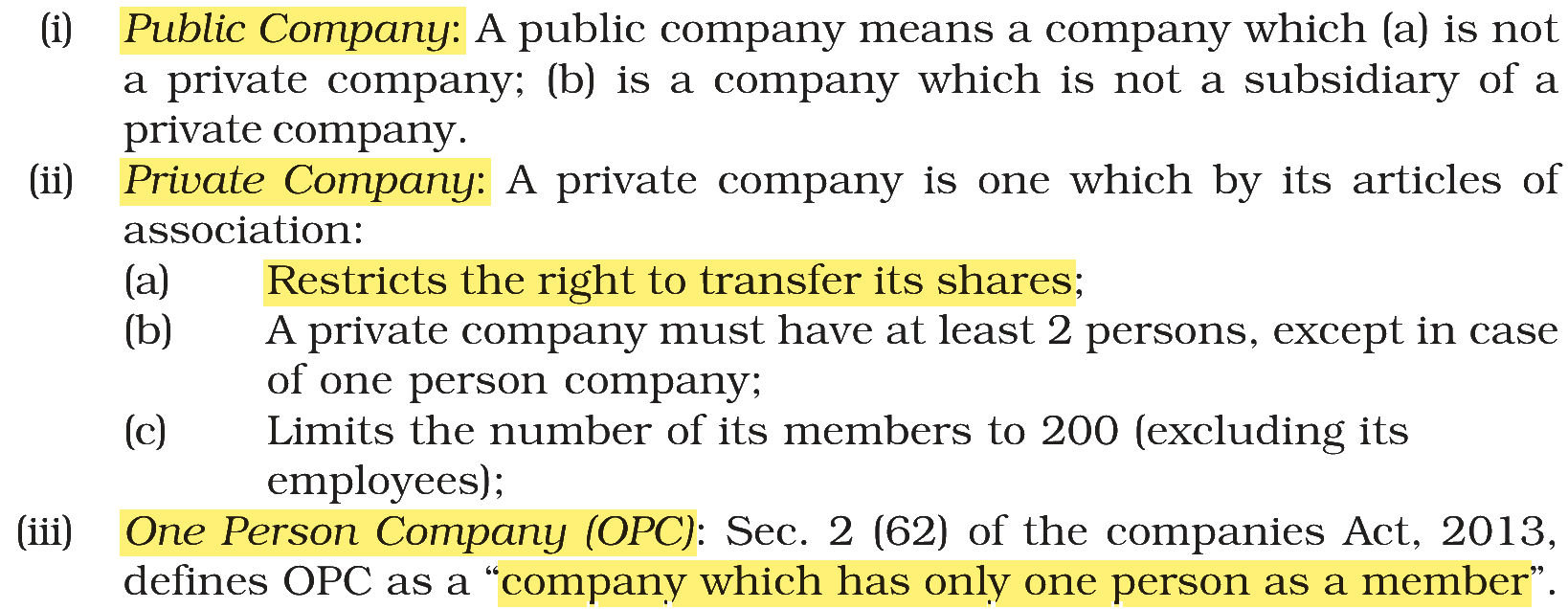
(A) Restricts the right to transfer its shares — this matches (II) Private Company. A private company is one which, by its articles, restricts the right to transfer its shares and limits its members to 200.
(B) A company which is a subsidiary of a public company — this matches (IV) Public Company. Under the Companies Act, 2013, a private company that is a subsidiary of a public company is treated as a public company, because its control rests with a public company.
(C) A company which has only one person as a member — this matches (I) OPC. Sec. 2(62) defines a One Person Company as a company with only one person as a member.
(D) Members may come and go but the company continues — this matches (III) Perpetual Succession. The company is an artificial person created by law, so the death, insanity or insolvency of a member does not end it.
NCERT (2026-27 edition):
NCERT (2026-27 edition): |