CUETMOCK
  • Pricing
  • Mentors
Log inStart freeStart free mocks→

First test, then trust

Try a free CUET mock test.

Join 5,00,000+ students who rehearsed exam day on the exact NTA screen before sitting CUET. On the web and on Android.

Start free mocks →Get the Android app
CUETMOCK

India's #1 CUET Mock Test Platform. Original NCERT-based questions on the exact NTA exam screen — trusted by 5,00,000+ students since CUET 2022.

Get it onGoogle PlayScan to download the CUETMOCK app

Mock tests

  • CUET mock test series
  • Commerce mocks
  • Humanities (Arts) mocks
  • Science mocks
  • Languages & GAT mocks
  • Free practice questions
  • Pricing

Resources

  • CUET exam guide
  • CUET syllabus
  • Universities accepting CUET
  • Expert blogs
  • News & notifications
  • Webinars & counselling
  • CUET score calculator
  • How we estimate your rank
  • FAQs

Company

  • About us
  • Our leadership & team
  • Our toppers
  • Mentors
  • For schools
  • Contact us
  • Terms
  • Privacy
  • Refund policy

Talk to us

+91 7696 6630 56info@cuetmock.comWhatsApp us

Our other platforms

  • JEE Mock — For IIT-JEE aspirants
  • NEET Mock — For NEET aspirants

Newsletter

Exam updates, study material and offers — no spam.

© 2026 NYC Ventures Pvt. Ltd.

701-702, Royal Business Park, Zirakpur, Punjab - 140603

  • Terms of use
  • Privacy policy
  • Refund policy
  • Contact us

iCUETMOCK is an independent preparation platform, not affiliated with the National Testing Agency (NTA). Always check exam details on the official NTA website.

  • Home
  • Mock tests
  • CUET guide
  • Pricing
  • Log in
Home/Practice questions/Chemistry
ChemistryOrganic: Aldehydes, Ketones and Carboxylic Acids

Consider the following compounds and arrange them in decreasing order…

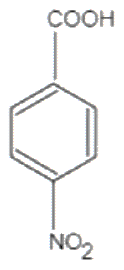
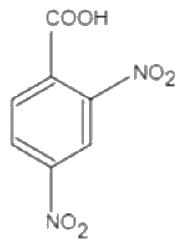
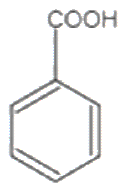
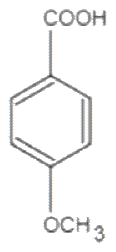
Consider the following compounds and arrange them in decreasing order of their acidity.

A.
Structure A for Q5

B.

Structure B for Q5

C.

Structure C for Q5

D.

Structure D for Q5

Choose the correct answer from the option given below:

Answer & explanation+

Correct answer: option 2

The correct answer is Option (2) → C, B, D, A

Electron withdrawing groups raise and electron donating groups lower the acidity of benzoic acid.

So, with benzoic acid as the reference:

    two EWG > one EWG > no substituent > EDG

Matching the given compounds:

  • (C) 2,4-dinitrobenzoic acid: two –\( \ce{NO2} \) groups (pKa about 1.4)

  • (B) 4-nitrobenzoic acid: one –\( \ce{NO2} \) group (pKa 3.41)

  • (D) benzoic acid: no substituent (pKa 4.19)

  • (A) 4-methoxybenzoic acid: electron donating –\( \ce{OCH3} \) group (pKa 4.46)

NCERT (2026-27 edition):
Effect of Substituents on the Acidity of Carboxylic Acids
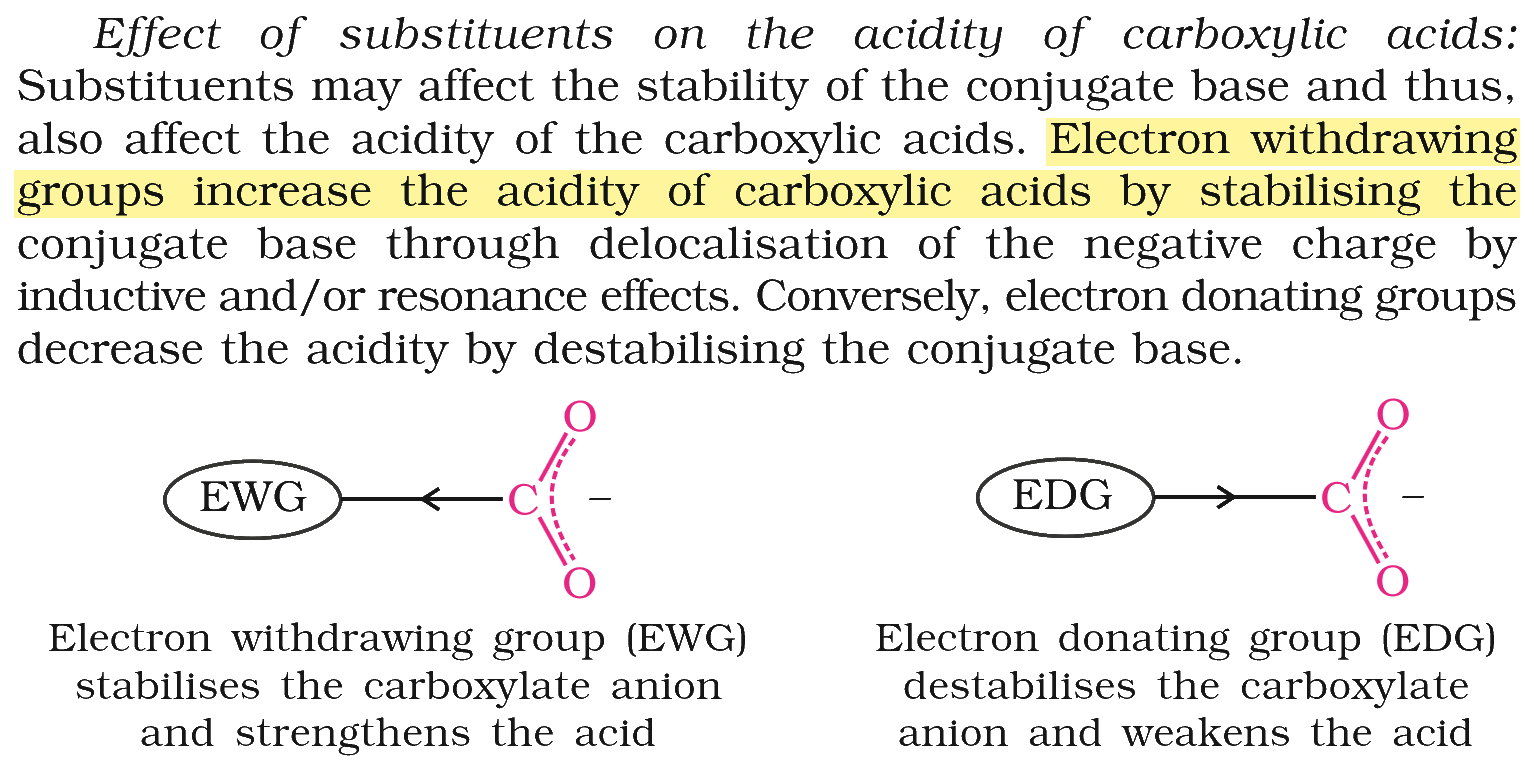
Textbook extract

Advertisement

Practise more on Organic: Aldehydes, Ketones and Carboxylic Acids

Chapter-wise mocks on the real NTA exam screen, with solutions and your rank. Your first mocks are free.

Start free mocks →

Advertisement

Next questions

  1. Select the most appropriate option to fill in the blank. It was a long and dangerous journey in those unsettled days. The pilgrim had to fa…English · Fill Blanks
  2. The murder of men is a common sight in history.English · One Word
  3. शब्दालंकार के भेद बताइए। (A) श्लेष अलंकार (B) अर्थालंकार(C) अनुप्रास अलंकार(D) यमक अलंकार (E) उभयालंकारनीचे दिए गए विकल्पों में से सही उत्त…Hindi · Alankar
  4. A solid lead sphere of radius 11 cm is melted and recast into small solid spheres of radius 2 cm each. How many maximum number (in integer)…General Aptitude Test · Quantitative Reasoning
  5. In the above figure, what will replace the '?' mark?General Aptitude Test · Non-Verbal Reasoning
  6. India's first lithium refinery, which will process lithium ore to produce battery-grade material, will be set up in:General Aptitude Test · General Knowledge
  7. Quick Ratio is also known as :Accountancy Part B · Accounting Ratios
  8. Arrange the following events in chronological order and choose the correct alternative(A) First Five year plan of China.(B) The great prole…Economics · Indian Economic Development: Comparative Development Experiences of India and its Neighbours
  9. The value of [(sin^227°+sin^263°)/(cos^224°+cos^266°)- sin^2 69° - cos 69° sin 21°] is :General Aptitude Test · Quantitative Reasoning
  10. If cot(cos^-1x) = sec […] , then x equalsMaths. Section B1 · Inverse Trigonometric Functions