The CFSE for octahedral \([CoCl_6]^{4-}\) is 18,000 cm–1. The CFSE for tetrahedral \([CoCl_4]^{2-}\) will be
Answer & explanation
Correct answer: option 4
The correct answer is Option (4) → 8,000 cm–1
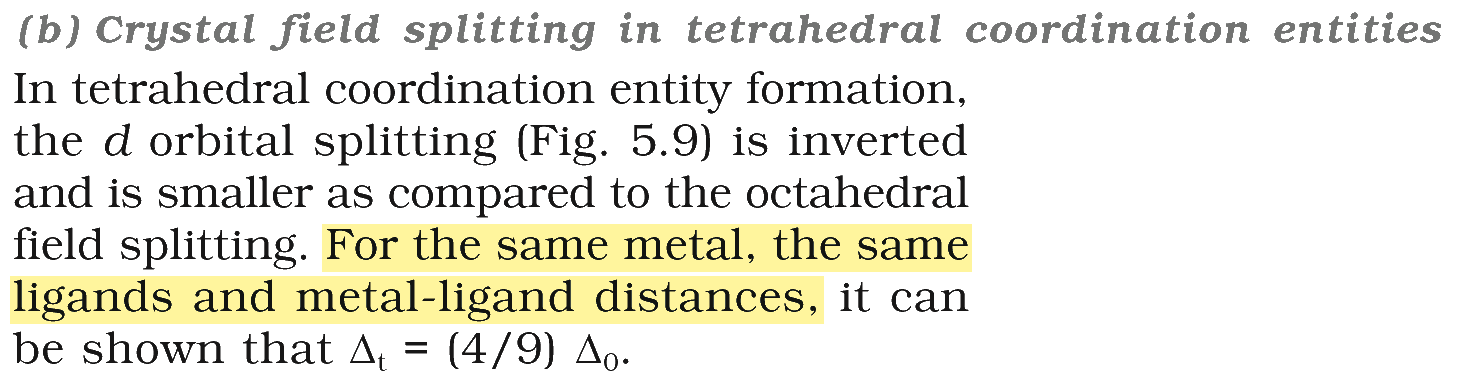
In an octahedral complex the six ligands point straight at two of the d orbitals, which split the d orbitals by Δo. In a tetrahedral complex there are only four ligands, and none of them points directly at any d orbital. The splitting is therefore inverted and smaller. For the same metal, the same ligands and the same metal–ligand distance:
\( \displaystyle \Delta_t = \frac{4}{9}\,\Delta_o \)
Both complexes here contain \( \ce{Co^{2+}} \) and \( \ce{Cl^{-}} \) ligands; the oxidation state of cobalt is +2 in each:
\( \displaystyle [\ce{CoCl6}]^{4-}: x + 6(-1) = -4 \;\Rightarrow\; x = +2 \qquad [\ce{CoCl4}]^{2-}: x + 4(-1) = -2 \;\Rightarrow\; x = +2 \)
The question uses the term CFSE for this splitting energy. Substituting:
\( \displaystyle \Delta_t = \frac{4}{9} \times 18000\ \mathrm{cm^{-1}} = 8000\ \mathrm{cm^{-1}} \)
So the value for tetrahedral \( \ce{[CoCl4]^{2-}} \) is 8,000 cm−1.
Shortcut: 4/9 is less than one half, so Δt must be below 18000/2 = 9000 cm−1. Only Option (4) is.
NCERT (2026-27 edition):
Crystal Field Splitting in Tetrahedral Coordination Entities