
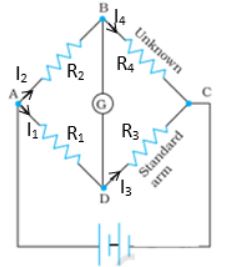
In a Wheatstone bridge, the resistances $R_1, R_2, R_3$ and $R_4$ present in four arms are 10 Ω, 30 Ω, 30 Ω and 90 Ω respectively. If the galvanometer resistance is 50 Ω and the voltage of the battery is 7 V and its internal resistance is 5 Ω, then the total current drawn from the battery is
Answer & explanation
Correct answer: option 4
The correct answer is Option (4) → 0.2 A
Given:
$R_1 = 10 \,\Omega,\; R_2 = 30 \,\Omega,\; R_3 = 30 \,\Omega,\; R_4 = 90 \,\Omega$
Galvanometer resistance $R_g = 50 \,\Omega$
Battery voltage $V = 7 \,\text{V}, \; r = 5 \,\Omega$
Balance condition check:
$\frac{R_1}{R_2} = \frac{10}{30} = \frac{1}{3}, \;\;\; \frac{R_3}{R_4} = \frac{30}{90} = \frac{1}{3}$
Hence, bridge is balanced. $\;\;\;$ No current flows through galvanometer.
Thus, the network reduces to two parallel arms:
Left arm: $R_1 + R_3 = 10 + 30 = 40 \,\Omega$
Right arm: $R_2 + R_4 = 30 + 90 = 120 \,\Omega$
Equivalent resistance of parallel combination:
$R_{eq} = \frac{40 \times 120}{40 + 120} = \frac{4800}{160} = 30 \,\Omega$
Total resistance in circuit:
$R_{total} = R_{eq} + r = 30 + 5 = 35 \,\Omega$
Current from battery:
$I = \frac{V}{R_{total}} = \frac{7}{35} = 0.2 \,\text{A}$
Final Answer: $0.2 \,\text{A}$