
Find the intervals in which the function $f(x) = 10 - 6x - 2x^2$ is strictly increasing or strictly decreasing.
Answer & explanation
Correct answer: option 1
The correct answer is Option (1) → Strictly increasing on $(−∞,−\frac{3}{2}]$ and strictly decreasing on $[−\frac{3}{2},∞)$.
Given $f(x) = 10-6x-2x^2, D_f= R$.
Differentiating it w.r.t. x, we get
$f'(x)=0-6.1-2.2x=-6-4x=-4\left(x+\frac{3}{2}\right)$.
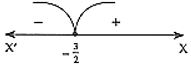
Now $f'(x) > 0$ iff $-4\left(x+\frac{3}{2}\right)>0⇒x+\frac{3}{2} <0$
$⇒x <-\frac{3}{2}⇒ x ∈\left(−∞,-\frac{3}{2}\right)$
⇒ f is strictly increasing in $(−∞,−\frac{3}{2}]$.
And $f'(x) < 0$ iff $-4\left(x+\frac{3}{2}\right)< 0$
$⇒ x+\frac{3}{2}>0⇒x>-\frac{3}{2}⇒ x∈(−\frac{3}{2},∞)$
⇒ f is strictly decreasing in $[−\frac{3}{2},∞)$.