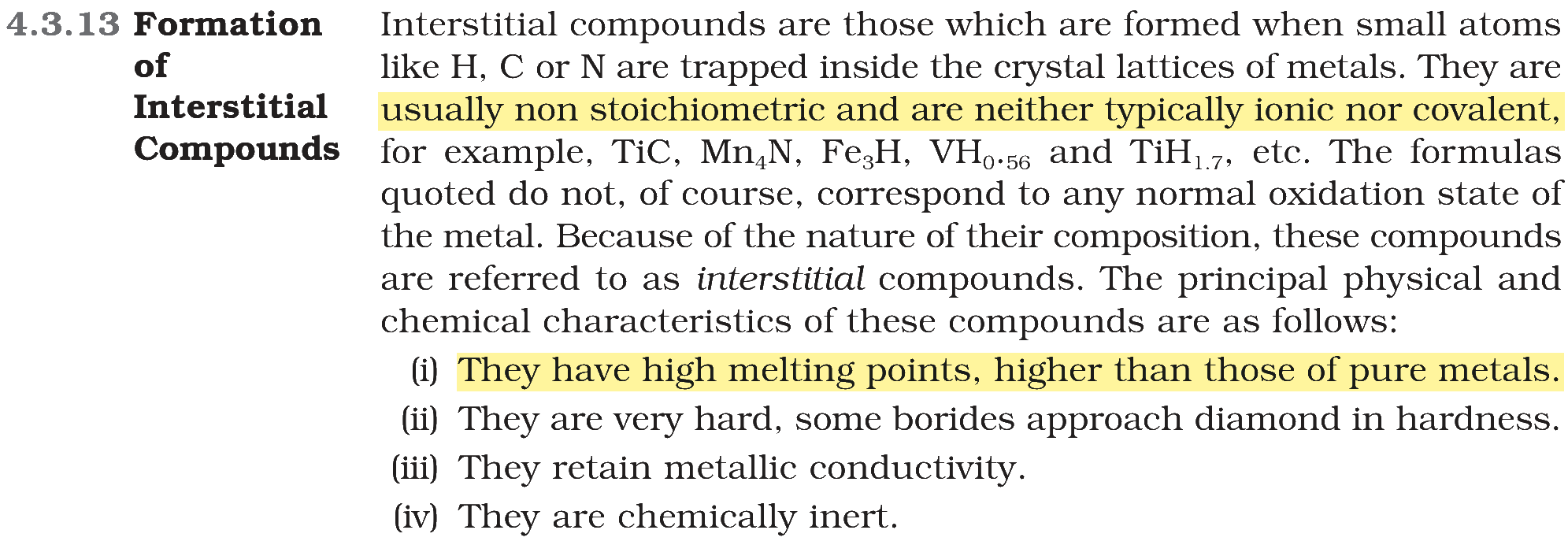
Choose the correct statements about interstitial compounds from the following:
(A) They have low melting points, lower than those of pure metals
(B) They are perfect-stoichiometric compounds
(C) These are formed when small atoms like H, C or N are trapped inside the crystal lattices of metals
(D) They are neither typically ionic nor covalent
Choose the correct answer from the options given below:
Answer & explanation
Correct answer: option 2
The correct answer is Option (2) → (C) and (D) only
(A) They have low melting points, lower than those of pure metals — Incorrect. Their melting points are high, higher than those of the pure metals.
(B) They are perfect-stoichiometric compounds — Incorrect. They are usually non-stoichiometric, such as TiH1.7.
(C) These are formed when small atoms like H, C or N are trapped inside the crystal lattices of metals — Correct. This is how they are defined.
(D) They are neither typically ionic nor covalent — Correct. The metal lattice and its metallic bonding are kept, with the small atoms held in the holes.
NCERT (2026-27 edition):
Formation of Interstitial Compounds