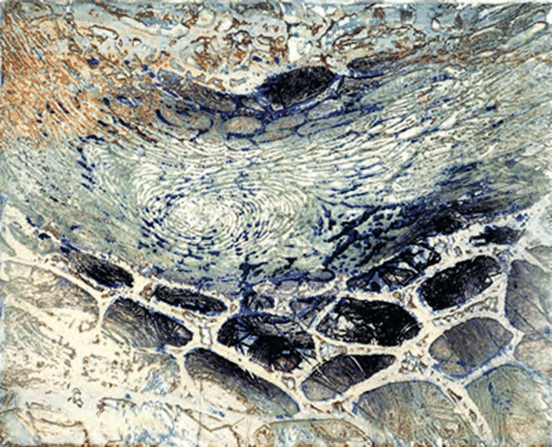
Krishna Reddy made the print Whirlpool in 1963 at the studio Atelier 17. Which technique was used to make it?
Answer & explanation
Correct answer: option 4
The correct answer is Option (4) → Viscosity printing
Option (1) Monochromatic etching with aquatint — Incorrect. Somnath Hore used it for Children; Whirlpool lays different colours on one plate.
Option (2) Line-based coloured etching — Incorrect. This describes Laxma Goud’s etching Rural South Indian Man–Woman.
Option (3) Fresco buono — Incorrect. This is a wall-painting technique, used by Benode Behari Mukherjee for The Lives of Medieval Saints.
Option (4) Viscosity printing — Correct. Reddy developed it with Stanley William Hayter at Atelier 17.
Note: This topic was not named in the CUET 2026 syllabus, but it was part of the NCERT chapter. In 2025 and 2026, NTA also asked questions on topics in NCERT that the CUET syllabus did not name. So our mocks have questions from every part of the NCERT chapter, to give you enough practice. Read the whole chapter, not only the sub-topics named in the syllabus.
NCERT (2026-27): “Whirlpool This was a print made by India’s celebrated printmaker Krishna Reddy in 1963. It is a captivating composition created out of various shades of blues. Each colour blends into the other to create a powerful web of design. It is the result of a new technique in printmaking that he developed along with a well-known printmaker, Stanley William Hayter, in the famous studio called ‘Atelier 17’. This method came to be known as ‘viscosity printing’, in which different colours are applied on the same metal printing plate.…”
|