Which one of the following reagents will selectively convert methyl propanoate to propanal?
Answer & explanation
Correct answer: option 4
The correct answer is Option (4) → DIBAL-H followed by work up with water
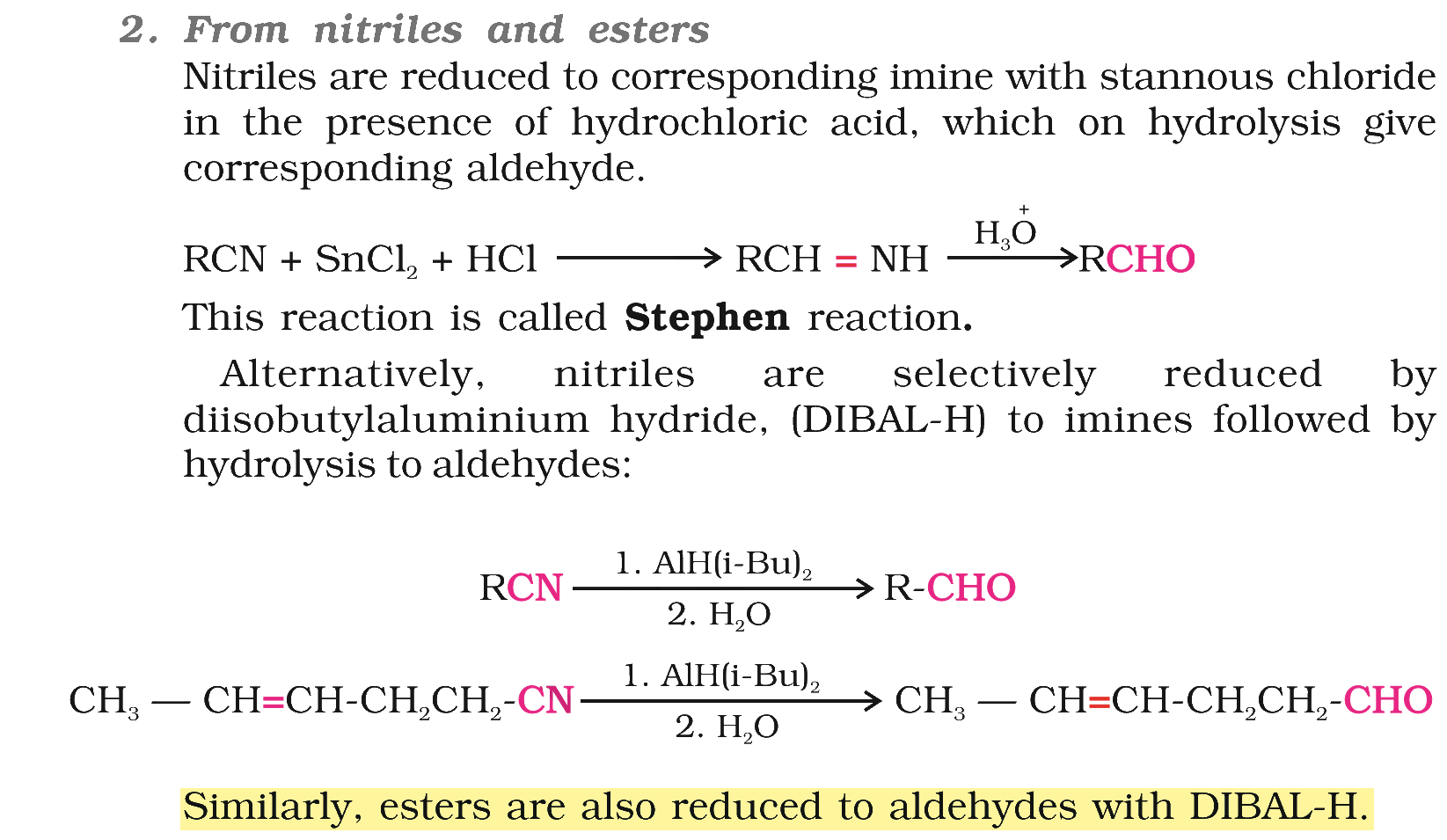
Reducing an ester to an aldehyde needs a reagent that stops after adding one hydride. DIBAL-H (diisobutylaluminium hydride, \( \ce{[(CH3)2CHCH2]2AlH} \)) is a bulky, mild reducing agent. At low temperature it adds only one hydride to the ester carbonyl, and hydrolysis then releases the aldehyde. The same reagent reduces nitriles to aldehydes.
Methyl propanoate gives propanal:
\( \displaystyle \ce{CH3CH2COOCH3} \xrightarrow[\text{(ii) }\ce{H2O}]{\text{(i) DIBAL-H}} \ce{CH3CH2CHO + CH3OH} \)
So DIBAL-H followed by water converts the ester selectively into propanal.
Why the other options are incorrect
Option (1) LiAlH4 followed by workup with water — Incorrect. \( \ce{LiAlH4} \) is too strong; it reduces the ester all the way to the primary alcohol, propan-1-ol.
\( \displaystyle \ce{CH3CH2COOCH3} \xrightarrow[\text{(ii) }\ce{H2O}]{\text{(i) }\ce{LiAlH4}} \ce{CH3CH2CH2OH + CH3OH} \)
Option (2) NaBH4 followed by work up with an acid — Incorrect. \( \ce{NaBH4} \) is a mild reagent that reduces aldehydes and ketones but normally does not reduce esters.
Option (3) H2/Pd — Incorrect. \( \ce{H2} \)/Pd does not reduce an ester group under ordinary conditions; it is used for C=C bonds and, with BaSO4 (Rosenmund reduction), for acyl chlorides to aldehydes:
\( \displaystyle \ce{R-COCl + H2} \xrightarrow{\ce{Pd-BaSO4}} \ce{R-CHO + HCl} \)
NCERT (2026-27 edition):
From Nitriles and Esters